

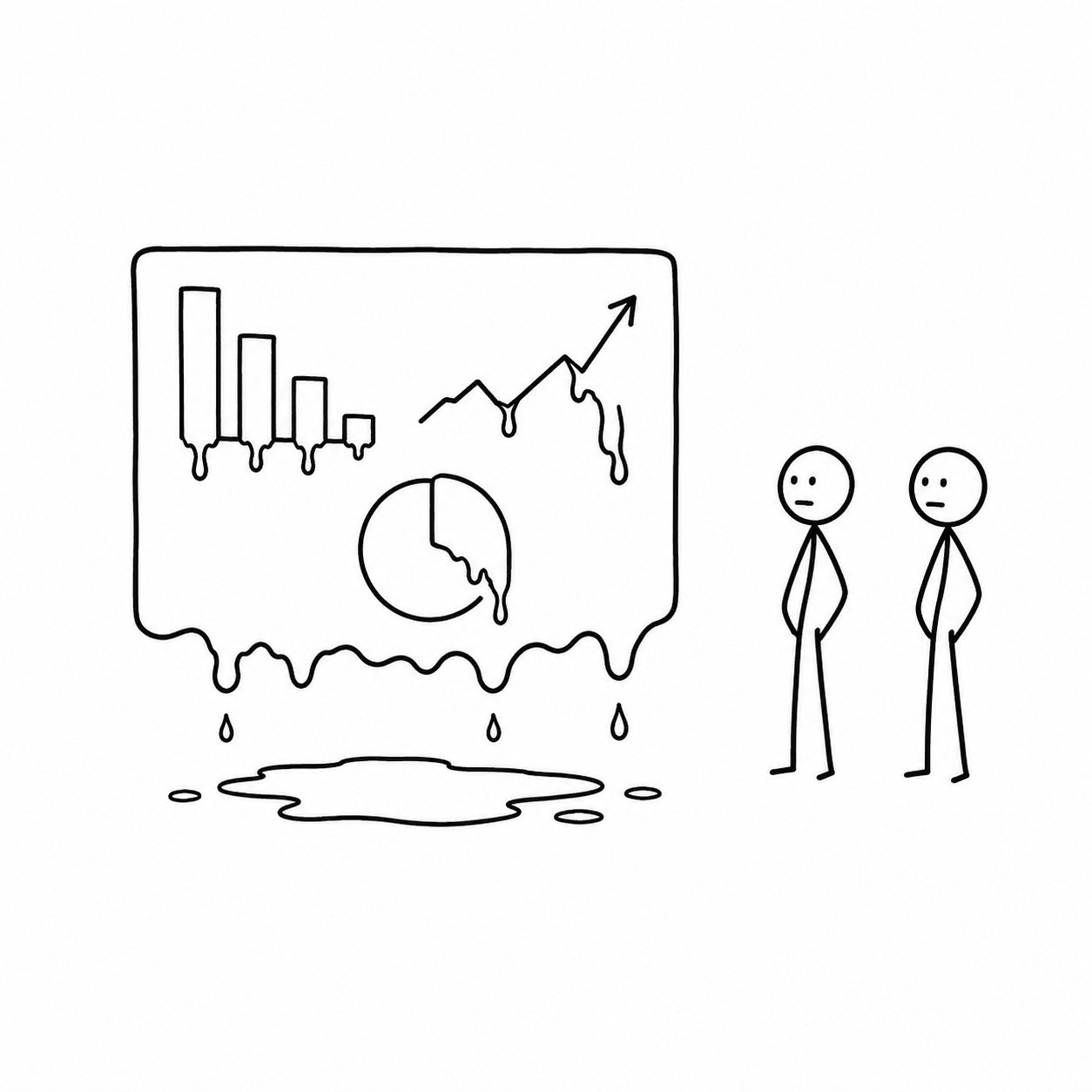
The dashboard is melting, and the two best test cases in independent BI are still standing next to it.
ThoughtSpot and GoodData are not the whole industry. They are the cleanest way to see what the industry cannot make itself do.
Ketan Karkhanis at ThoughtSpot was brought in after the AI shock was already visible. Roman Stanek at GoodData owns the company’s identity in a way only a founder can. Both can see what is coming. Both have more room to move than most.
Neither is moving far enough.
The reason is gravity.
Days ago, dbt showed everyone the easy way out.
No drama. No collapse. On June 1, the Fivetran merger closed, and Tristan Handy, the man who spent a decade making dbt the default grammar of the modern data stack, started reporting to Fivetran’s George Fraser.
That is not a tragedy.
It is an exit.
The side door.
Last October, I argued that this was where the BI market was heading: not one spectacular collapse, but a wave of acquisitions, mergers, take-privates, and strategic absorptions. I won’t pretend I predicted this specific deal. It was announced before my piece ran, and you should distrust anyone who predicts anything really.
But it looks like that wave is here.
Take the old thesis as given: AI commoditizes the analytics artifact. Dashboards, charts, reports, the objects BI vendors sell, become things an agent can produce on demand for the price of tokens.
So the escape is not a better dashboard.
It is decision infrastructure: the thing we cannot truly name, but the one that carries the decision, and demotes the dashboard to an input.
That leaves every independent BI vendor with two doors.
The side door: sell, merge, go private, or get absorbed into a larger platform where BI becomes a feature, not the business.
The front door: use the remaining strength of the old business to build the thing that replaces it, decision infrastructure, while deliberately cutting the three things that still make the old business work: (1) the seat model, (2) the data-team buyer, (3) and the dashboard product. Cut them and trade them for the new world of BI.
Why these three? Because nobody keeps paying $5k a seat for artifacts an agent makes on demand. Because decisions are bought by the executives who own them, not by the team that buys dashboards. And because the dashboard was only ever a proxy for the decision, you don’t survive the commoditization of proxies by shipping a better proxy.
That is the real problem.
Every BI vendor can imagine the future. Of course they can. Their CEOs read the same market signals, hear the same customer complaints, and know the dashboard is becoming less defensible every month.
But imagining the future is cheap.
Authorizing it is the hard part.
Because each of those cuts attacks a part of the company that is still alive. Outcome pricing threatens seat revenue. Selling to decision owners threatens the data-team motion. Making the tracked decision the product threatens the dashboard itself. From inside the current P&L, every correct move looks like self-harm.
So the question is not whether an incumbent can see the decision-infrastructure play.
The question is whether anyone inside the company has enough standing to let the current business lose to it.
And when I look across independent BI, I can only think of two sitting CEOs who might plausibly have that standing.
That is why this piece is about ThoughtSpot and GoodData.
Not because they have made the cuts and trades.
Because they are the two clearest places where the trades might still be authorized.
So here is the front-door test: three trades, one signature.
If you only have 5 minutes, here are the key points:
Every independent BI vendor now has two doors: the side door, sell, merge, go private or the front door: three non-fun trades.
Trade 1, the seat for the outcome. Agents produce dashboards on demand for the price of tokens; the per-seat license is commoditizing to zero. The industry’s recent seat-price hikes are the dying model defending itself, not saving itself.
Trade 2, the data team for the decision-owner. The buyer has already split: Statsig and Celonis sell decision tooling into COO and product budgets, while every BI vendor still runs the Gartner-ABI motion at the data team, the customer that is also the immune system against anything that makes dashboards optional.
Trade 3, the dashboard for the decision. The architecture already works one aisle over: Optimizely and Statsig productized the experiment; Aera and Celonis track decisions against expected outcomes. Three years of “agentic” releases in BI have upgraded the artifact, not one has touched the decision.
Why nobody signs: each trade surrenders something that pays today’s bills for something that doesn’t pay yet. That takes standing, the authority to approve the trade and fund the replacement from the center, out of reach of the P&L it threatens. Kodak funded digital from inside the film business and starved it; Fuji funded it from the corporate center and lived.
The evidence and the bet: pricing pages, sales motions, and release notes say neither Karkhanis nor Stanek has made a single trade. My bet: the next 18 months bring more side-door exits and zero front-door survivors, unless one of these two proves me wrong.
Let’s start with the money.
Trade 1: Price the outcome, or price nothing
The first trade is the money. Stated plainly: stop earning when analytics gets produced, and start earning when a decision pays off. That means giving up every pricing model that bills for output: seats, queries, credits, workspaces, AI questions, in favor of a model that fits in one sentence: we get paid when the decision we helped track produces the result we agreed on.
To be precise about what this is not: moving from seats to consumption is not this trade. Adding AI query buckets is not this trade. Inventing a clever credit system is not this trade. Those are changes to how output gets counted. The trade is to stop pricing output altogether.
Why make it? Because output is losing its value as a thing to charge for. The BI seat priced a world where a human in a chair was the unit of analytics production: someone logged in, explored the data, built the dashboard, answered the question, and so you priced the person. Once an agent produces or reads the same artifact on demand for the price of tokens, the seat loses its economic anchor. Renaming the meter does not restore it, because every output price inherits the same problem. Output is exactly what stopped being scarce.
What stays scarce sits downstream: did the promotion lift margin, did the retention action reduce churn, did the inventory decision cut working capital without hurting service levels, did the sales intervention move pipeline. That is where the money has to move, because that is the only thing left that a customer cannot get cheaper somewhere else.
ThoughtSpot and GoodData are the useful receipts here, because both have shown genuine pricing nerve.
ThoughtSpot moved from seats to consumption and marketed the move as liberation from “user based pricing and shelfware,” their words. Today, Ketan Karkhanis signs off on a page where the headline AI agent, Spotter, is sold through questions and caps.
GoodData went further, earlier: Roman Stanek abandoned seats entirely for workspace pricing, unlimited users, pay per container, probably the boldest pricing move in BI. Yet the AI layer is still packaged as AI capacity, not priced against decision outcomes.
Both companies have proven they can change their pricing model.
Neither has changed what the model prices.
Why does nobody make the trade, then? Because the old pricing model is not a habit. It carries a vote! It pays the salaries, funds the roadmap, makes the board deck legible, and gives the sales team something it knows how to sell. Removing it can look, from the inside, like vandalism.
Blockbuster is the clearest case on record. Late fees had once brought in roughly $800 million a year and had become one of the company’s most hated profit engines. By 2005, when John Antioco moved to abolish them, Blockbuster itself said late fees would otherwise have contributed $250 million to $300 million to operating income. Everyone outside the company could see the customer problem. From inside the P&L, abolishing the fee line looked like setting money on fire.
That is the incumbent trap: the thing your customer hates may be the thing your company depends on. Customers do not want more seats, dashboards, or AI answers. They want better operating decisions. But seats, dashboards, and AI answers are what the vendor knows how to bill for, so the correct move reads, internally, as self harm.
Can it be done anyway? Yes, but not gently.
In 2013, Adobe stopped selling Creative Suite as perpetual licenses and pushed the business into Creative Cloud subscriptions. Same species of trade: give up the model that pays today for one that compounds tomorrow.
And it hurt. Customers hated it. A petition begged Adobe to keep selling packaged software. Revenue fell during the transition, and Adobe told investors the shift was hurting net income and operating margin because expenses did not fall with license revenue.
The lesson is not that BI should copy subscriptions. BI already has subscriptions. The lesson is that a software company can walk away from the pricing model customers know, investors understand, and sales teams are built around, if the new thing it prices compounds better than the old one.
But here is where BI hits the current wall: outcome pricing is not available as a pricing change alone. To price an outcome, you have to track the decision, a product BI vendors do not build. And you have to bill the person who owns the result, a customer BI vendors do not sell to.
Trade 1 is really Trades 2 and 3 wearing a price tag.
Which brings us to the second trade.
Trade 2: Move the invoice to the decision owner
The price cannot reach the outcome because the invoice goes to the wrong desk. That is where Trade 1 ended, and it is where Trade 2 has to begin: the second trade is the customer. Give up the buyer BI vendors know best, the data team, the analytics team, the BI lead, the dashboard owner, and sell instead to the person who owns the decision: the COO, the CRO, the head of supply chain, the growth lead, the GM of a business line.
Not as a new logo on the same sales deck, but as a different buyer, in a different budget, measured on a different number. Why must the buyer change? Because the data team cannot buy the thing the new model prices. This is not a knock on data teams and it is not about talent; it is about mandate. A data team is measured on access, trust, governance, self-service, semantic consistency, dashboard adoption, and the speed and reliability of reporting.
Those are real responsibilities, and a good data team takes them seriously, but none of them is a business outcome.
The decision owner is measured on different things entirely: churn, margin, conversion, inventory, sales velocity, fraud loss, product activation, throughput. The two roles do not share a number. So the data team can buy better answers, faster queries, cleaner models, more governed metrics, wider adoption, but what it cannot buy is accountability for what the business actually does with those answers.
Decision infrastructure is priced against that accountability, which means, almost by definition, it cannot be bought by the current BI buyer. This is not a strange move; it is what changing the referent usually requires. The New York Times did not escape the collapse of print advertising by inventing cleverer ad units. It pushed toward reader subscriptions, and that meant changing both what it charged for and who it served. The old buyer was an advertiser who wanted audience attention; the new buyer was a reader who wanted journalism worth paying for. The new meter and the new buyer arrived together because they had to: you cannot organize a company around what a reader will pay for while still answering to what an advertiser values. That is the shape of the BI trade.
You cannot charge for decision outcomes while the company is still built around the buyer of analytics output. One aisle over, the split is already visible. Statsig does not sell better dashboards; it sells experimentation and product-decision infrastructure into product organizations whose numbers are activation, retention, and release velocity. Celonis does not sell better analytics; it sells process intelligence and operational execution into the COO-and-CFO world, where the numbers are cost, throughput, and working capital.
The market for decision infrastructure is not hypothetical, it exists right now. It is simply being served by vendors who never had a dashboard business to protect, and who therefore never had to make this trade. They started on the far side of it.
Why is the trade hard, then? Because the old buyer is not only the customer. It is also an immune system. The data team owns the existing tool stack, controls the evaluation criteria in any bake-off, speaks fluent Gartner, and is the internal sponsor whose budget and credibility are tied to the current product.
That makes it the most natural sponsor a BI vendor has, and the most effective antibody against anything that would make the dashboard optional.
Sell decision infrastructure through that buyer, and it gets domesticated on the way in. “Did this decision improve the operating metric?” becomes “Can it answer governed questions over our semantic layer?” The new thing is translated back into the language of the old thing, scored on the old criteria, and shelved next to the dashboards it was meant to replace.
On June 18, 2025, GoodData celebrated its inclusion in the Gartner Magic Quadrant for Analytics and BI Platforms. ThoughtSpot celebrated the same category, in the same frame.
That is not a sin.
It is good category execution.
But it is also the tell.
When the achievement you announce is your standing in the buyer’s existing category, you have told the market which desk your invoice still goes to.
Thing is, if you want to sell to the people who own decisions, you cannot keep handing them dashboards. You have to give them the decision itself.
Trade 3: Make the decision the product
The third trade is the one the industry is trying hardest to look like it has already made.
Give up the dashboard as the product. Make the tracked decision the product. The dashboard does not disappear. It gets demoted to an input: evidence, context, source material. The thing you sell, support, and stake the company on is no longer the artifact that displays the data, but the record of the choice the business made and what came of it.
Why make the trade? Because the dashboard was only ever a proxy. Nobody ever wanted a dashboard. They wanted a decision made well under uncertainty: a choice, with an owner, an expected impact, an action taken, and a result that came back better or worse than expected. The dashboard was the stand-in. A human read the chart, carried the context, made the call, and remembered, badly, what happened afterward.
AI does not retire the proxy. It makes the proxy instant. And you do not survive the commoditization of proxies by shipping a faster proxy.
The difference is easiest to see in one word. A dashboard refreshes. A decision record remembers. A dashboard answers: what is happening right now? A decision product answers a longer question: what did we decide, who owned it, what did we expect, what actually happened, and what do we change next time? That is not a chart with better styling. It is a different unit of work, one where ownership, expectation, action, and follow-up are first-class parts of the object instead of living in someone’s memory, a forgotten Slack thread, or the last five minutes of a meeting.
One aisle over, this architecture already runs in production. Optimizely and Statsig productized the experiment: hypothesis, exposure, measured result, rollout decision, recorded outcome. Celonis and Aera productized operational execution: a process observed, an intervention recommended, an action taken, a result tracked. None of these companies set out to build a smarter dashboard. They made the unit of their product something downstream of analysis, and the chart became one input among several. That is the move.
Why is the trade hard, then? Because this is the one that cuts the company’s idea of itself.
Trade 1 costs a worse year of revenue.
Trade 2 costs a familiar sales motion.
Trade 3 costs identity.
A BI company is organized, top to bottom, around analytics artifacts: the product org builds analytics features, the roadmap is a queue of analytics improvements, the demo opens on a dashboard, the sales engineer shows charts, the reference customers praise dashboards, the analysts rank the company inside “Analytics and BI.” Make the tracked decision the product, and most of that has to be rebuilt or retired. This is not cutting a SKU. It is cutting what the company believes it is. And a company will defend its self-image harder than it defends any single line of revenue.
In September 2025, ThoughtSpot launched what it called “Boundaryless, Agentic Intelligence,” with Spotter as the headline agent. It is good engineering. But look at what the agent does: it asks, answers, visualizes, explains. That is artifact logic, accelerated. GoodData is closer to the line than most of the market; its public language now points toward agentic, embedded decision-making. But the product orbit still gives it away: a governed semantic foundation, metrics, embedded analytics, AI answers, assistants, alerts, reports. The orbit is still analytics. Both companies took their biggest recent swing and made the proxy faster, smarter, more conversational. Neither replaced it with the decision record.
The pricing page still prices output. The sales motion still points to the analytics buyer. The product still improves the dashboard. None of this is irrational.
Which is why the question is no longer product strategy. The question is authority.
The gate: two powers, and almost nobody holds both
Not vision, not product taste, not whether the CEO has read the market correctly. By now the diagnosis is almost boring: the pricing page still prices output, the sales motion still points to the analytics buyer, the product still improves the dashboard.
That is what happens when every part of the company is allowed to make the sane decision in its own corner. Pricing protects revenue, sales protects the buyer, product protects the artifact. Each local choice is reasonable, and together they are fatal. So the front door has a gate, and the gate is not intelligence.
It is standing, and standing means two powers, not one.
The first is the power to make the old business lose on purpose. Someone has to sign the cut: kill the seat model, walk away from the data-team buyer, demote the dashboard.
The second power is the real one: the power to fund the replacement from outside the P&L it threatens.
It is not enough to approve the new thing; you have to protect it from the old thing. Because if decision infrastructure is funded inside the analytics P&L, it will be judged like analytics, and if it is judged like analytics, it will lose. It will be asked to defend seat revenue, please the data buyer, pass the Gartner bake-off, reuse the dashboard demo, and produce a pipeline number by next quarter.
This is the Kodak lesson: Kodak saw digital, had digital, and spent years and serious money trying to renew itself. The trouble was that the new logic kept having to survive inside the economics, expectations, and identity of the old one.
Film was not just a product line; it was the profit engine, the measurement system, the customer relationship, the culture, the thing that made Kodak Kodak. Digital could be approved. It could not be allowed to make film lose fast enough. Kodak cleared the first gate and never cleared the second.
Fujifilm is the cleaner contrast. Fuji faced the same collapse in photographic film but treated the old business as a funding source for a corporate-level transformation rather than a thing to defend, it cut hard and moved its underlying capabilities, the chemistry and imaging and materials, into adjacent businesses where they could matter again.
Not one neat pivot, but a redeployment funded from the center.
Put the two powers together and you can see why most BI vendors will take the side door. A head of product cannot do this; neither can a sales leader, nor a pricing committee, nor even a visionary founder if the board, the P&L, and the quarterly cadence still require every new initiative to defend the old business by Friday.
The person who signs has to be able to say four things at once and mean all of them: yes, this will hurt the current revenue model; yes, this will bypass the current buyer; yes, this will make the current product less central; and yes, I will fund it from the center anyway. That combination is the signature, and it is rare on purpose.
Which brings us back to the two men. Ketan Karkhanis has imported standing, he did not spend his career building ThoughtSpot’s old P&L, but was brought in from outside after the AI shock was already visible, with the kind of mandate a fresh CEO gets to remake a company if he chooses to spend it.
Roman Stanek has owner standing, he founded GoodData and has lived with it long enough to know exactly what must be protected and what must be killed, and a founder can overrule the organization’s self-image in a way a hired executive almost never can. That is why they are the two obvious candidates I can see in independent BI. Not because they have made the trades, but because they might still be allowed to authorize and fund them.
The evidence so far points the other way.
Karkhanis is still pricing the agent in the old language, still selling through the old category, still accelerating the old artifact.
Stanek is closer on language, closer on pricing nerve, perhaps closer on architecture. But the public motion still orbits analytics: workspace pricing, AI capacity, semantic foundation, embedded analytics, Gartner validation accepted with pride.
Both men hold the standing. Neither has yet spent it to make the old business lose. And standing that is never spent is indistinguishable, from the outside, from not having it at all.
So the side door remains. Not because the future is invisible. Not because the products are bad. Because the old business is still winning every internal vote. Pricing votes for output. Sales votes for the data team. Product votes for the dashboard. Finance votes for the P&L. Gartner votes for the category.
Every room makes the sane decision, and the company dies by consensus.
That is why dbt’s exit matters. It is not an exception to the pattern. It is the pattern with a signature on it. My bet is still the same: more side-door exits, zero front-door survivors.
Further reading
This is starting to turn into a series, and I noticed one piece is missing!
https://www.thdpth.com/p/bi-industry-death-is-inevitable-your describes my estimate for the death waves (Phase 3 = Acquisition wave) and potential paths forward for tool builders, practitioners and everyone else. Key point: It was always about the decision, not the data, nor the dashboard.
https://www.thdpth.com/p/what-comes-after-analytics then goes on to argue very explicitly on what (and how) YOU should build = decision infrastructure (everything supporting decisions). But one key point: Incumbent’s can’t really. Making this all about start ups.
Next Up “So how does it really look like” because in all fairness, this is all cheap talk unless I can start to draw up a more clearer picture on how “decision infrastructure” and “AI native analytics and data products” actually look like. So…. stay tuned…