

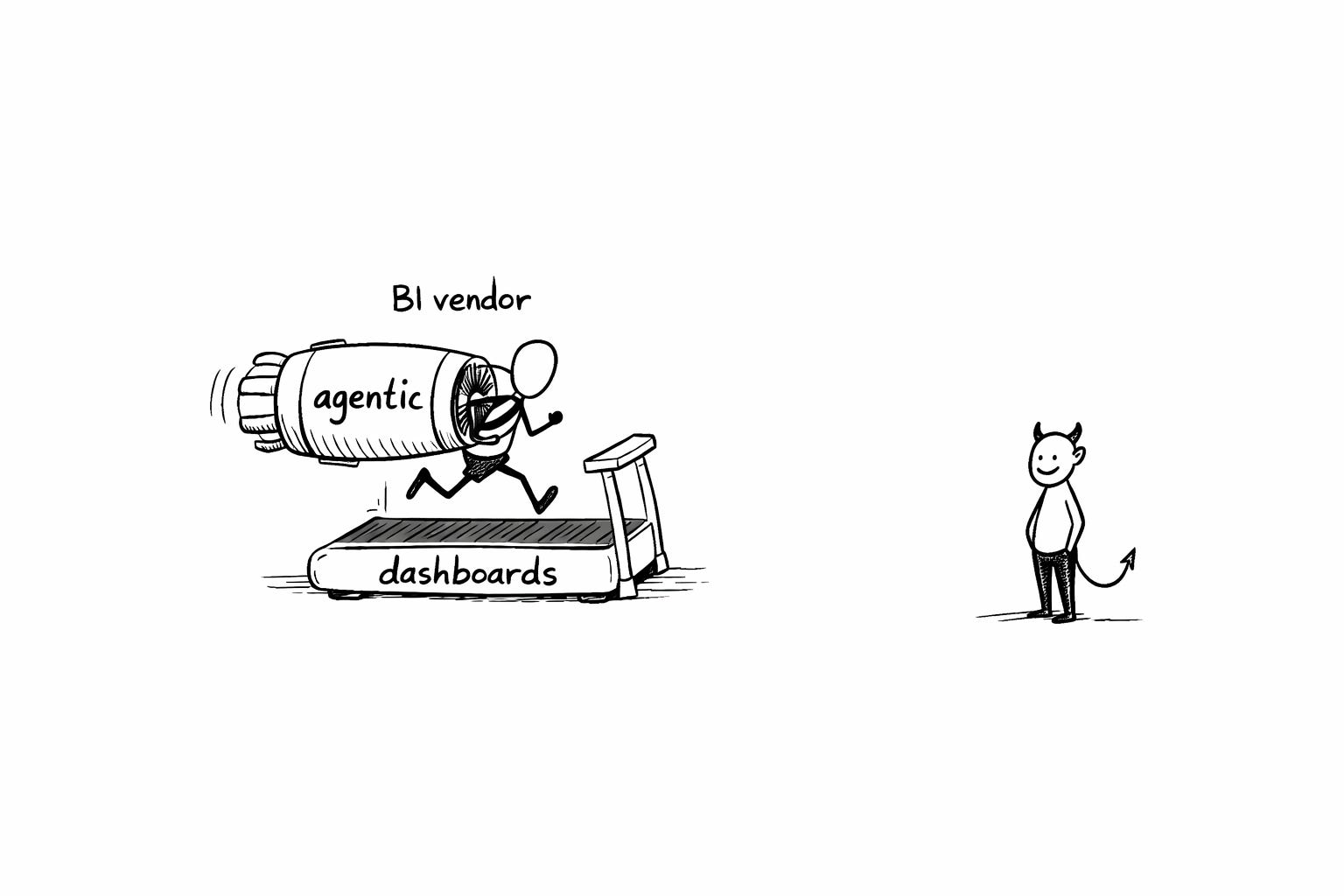
The entire “agentic” wave optimizes the same proxy. Here’s what I think should actually exist instead.
On a Tuesday, a founder called me in the morning. He’d read most of what I’d written about BI, about how AI is commoditizing dashboards. He agreed with all of it. We’d had a long conversation about what the real opportunity looked like, about decision making and driving business outcomes, the stuff nobody builds.
Then he said the sentence: “Sven, we gotta make money today.”
A week later he launched a BI tool for data analysts.
That afternoon, I had a call with a senior executive at one of the larger BI vendors. Totally different context. We totally agreed on the biggest challenges and the vision. In fact, I was impressed — this company has had this outlook for years. Then he dropped the line on me: “Sven, we see all of this. In fact, we’ve been working on this from the beginning. But we have to make money today.”
Two conversations on the same Tuesday, same sentence. One founder who sees the future but builds the past. One executive who’s been seeing the future for years and still ships the past every quarter. Both trapped by the same five words.
I’ve now heard some version of “we gotta make money today” from enough founders, VPs, and CEOs that I can tell you exactly what it means. It means: I know what’s wrong, I can describe it in detail, but I can’t see a way out.
They’re wrong. Not about the difficulty — building decision infrastructure (= enabling better decisions) is harder than shipping another dashboard with AI bolted on. But about the inevitability. They act like the cage is permanent. It’s not. It’s a structural trap with a specific shape, and once you see the shape, you can build around it. If you’re an incumbent, this could be your map out of it. If you’re a startup, I think this is one of the biggest greenfield opportunities in enterprise software right now.
Let me spell out the cage first. Then we’ll talk about what to build instead.
Note: “The Last Mile of Analytics” was/is this hot trend/concept in analytics. The idea was exactly what is now begetting the downfall of the sector: Insights must be turned into actions otherwise there’s no value for the company AT ALL. The analytics sector correctly identified this, and then expertly failed to execute on this insight, assuming that we “first must get lots of data, then analyse it, and then turn it into action” (Ask any decision maker and you’ll notice, he’ll be just fine making decisions without first consulting an analytics team first.) ⇒ The “Last Mile of Analytics” might really turn into the Last Mile of the Analytics Industry.
Six vendors, same sentence, same trap

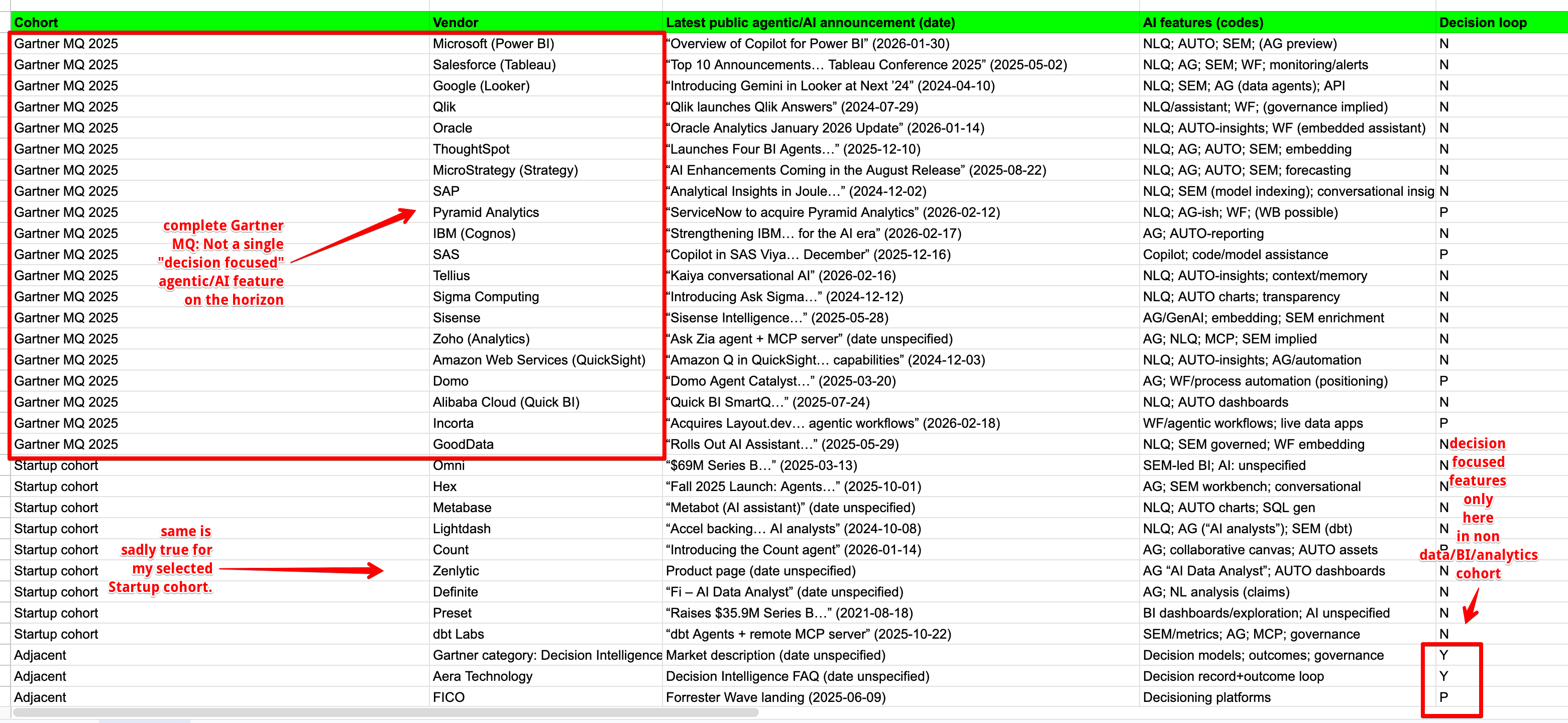
I went through every major BI vendor’s latest “agentic AI” announcement — if you want to do so too, I suggest the 2025 Gartner Maigic Quadrant for Analytics and BI, plus every hot startup like Hex, Omni, Lightdash, Metabase, Count, Zenlytic, Definite, Preset, dbt Labs. A sample (more details here):
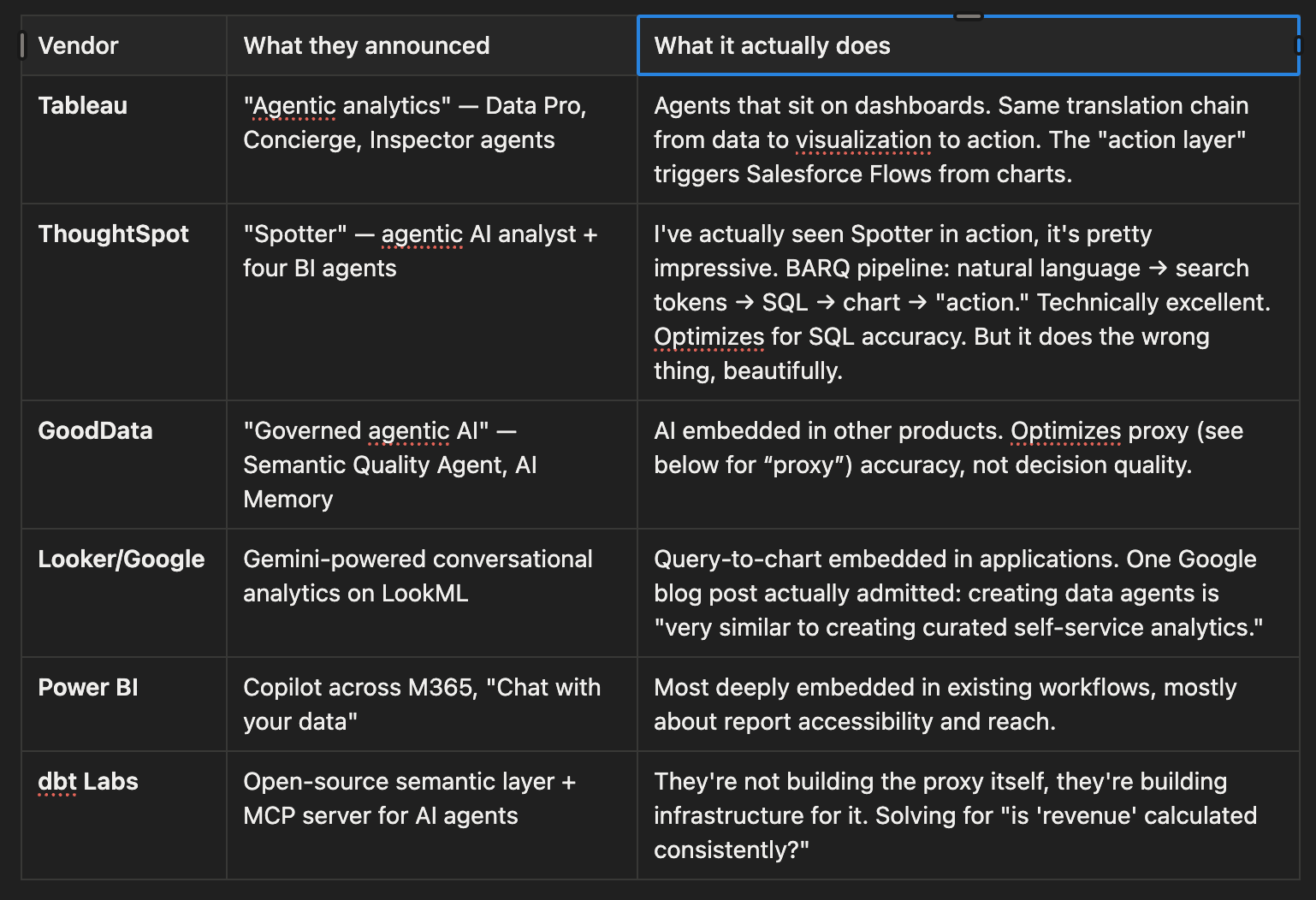
It’s basically the same product with different logos.
Every vendor optimizes a different facet of the same thing: making the analytics artifact (dashboard, chart, report) faster or easier to produce. Tableau makes it agentic, ThoughtSpot makes it conversational, GoodData makes it governed, Looker makes it embeddable, Power BI makes it accessible, dbt makes it consistent.
But none of them touches the decision. (Seriously, feels like analytics companies now aren’t able to say “decisions” anymore)
And for what it’s worth — in those two Tuesday conversations, it was pretty clear that both the founder and the executive weren’t really concerned with decision-making inside companies. Not at the macro scale, not as the thing they were building for. They were concerned with data analysis, with dashboards, with making the analytical artifact faster. But that’s what happens when you reduce BI to data analysis. You stop seeing the thing BI was always supposed to serve.
And it’s not because they don’t see it. GoodData’s CEO Roman Stanek said: “Most companies don’t need more dashboards; they need clarity.” Looker’s VP of engineering acknowledged BI has been “the same dashboards and reports” for twenty years. And both then shipped more dashboards with AI.
And that’s the weird part, right? Individual humans inside these companies diagnose the problem perfectly. But the organization — its revenue model, its customer expectations, its Gartner rating, its roadmap, its analyst relations — structurally cannot escape. The CEO sees the trap, but the company basically is the trap.
This is why every “agentic analytics” announcement is basically the same product. It’s not a strategy choice, it’s a structural inevitability. The old pattern can only produce more of the old pattern.
The best way I can describe what’s happening: it’s putting a jet engine on a treadmill. Genuinely impressive engineering. You’re running faster than ever. And you’re still not going anywhere. Spotter, Tableau Next, Copilot for Power BI, Gemini in Looker — they’re all jet engines strapped to treadmills. The destination — a decision process that actually improves over time — was never part of the machine.
SIDE NOTE: Gartner themselves predict that over 40% of agentic AI projects will be cancelled by end of 2027 due to escalating costs, unclear business value and inadequate risk controls. So the decay might already be built in. “Agentic” is looking more like a marketing cycle than a product category - and at the same time, agentic is super charging all of my processes (including the writing of course), so the tech is powerful, it’s just not used with the right goal in mind.
The proxy trap: why CEOs can’t escape
So why does every vendor build the same product? Because the trap isn’t strategic, it’s structural.
Companies don’t have a data problem. They have a decision-making problem. Nobody designed how decisions get made. The decision process was never built. It’s accidental, political, meeting-based, vibes-based. But fixing that is invisible, cultural, and hard — there’s no vendor for it. So organizations do the legible thing: hire data people and buy tools. “We need better decisions” becomes “we need a data team.”
The proxy is born. And then it runs on autopilot. Let me walk you through how this plays out, step by step.
First, the proxy gets invented instead of the fix. “We need better decisions” becomes “we need a data team” becomes “we need dashboards” becomes “we need Tableau.” The stand-in replaces the fix before the fix was ever attempted.
Then the proxy grows its own economy. Data teams justify headcount by producing dashboards. Dashboards need tools. Tools need vendors. Vendors market to data teams. An entire industry services a substitute for the thing nobody built.
And here’s the really tricky part: the proxy actively prevents the fix. Leadership says “we’re data-driven, we have a data team.” The dashboard thing absorbs the anxiety. This is why almost no company does PR/FAQ or WBR — they already feel like they’re addressing the decision problem because they have dashboards.
On top of that, the proxy can’t diagnose itself. A data team can never tell you “you don’t need us, you need a decision-making process.” Even when CEOs personally see it — like Stanek, like the Looker VP — the organization can’t act on it.
And then AI comes along and commoditizes the proxy without fixing anything underneath. AI commoditizes SQL, dashboards, and insights. But it doesn’t fix the decision process. Companies that relied on that substitution are suddenly naked.
So the industry panics and builds proxy-for-proxy. That’s the vendor table above. Thirty-plus companies building shinier dashboards at double speed.
That’s the cage. Your product can’t be adopted through proxy channels — data teams, BI budgets, analytics conferences — because those are the proxy’s immune system. Incumbents will never build the fix because their organizations structurally can’t. And the window is now, because AI is stripping the proxy away and organizations are about to discover they have no decision process underneath.
The way out, I think, is building the thing that was never built in the first place: decision infrastructure. The processes, systems, and feedback loops that make decisions visible, trackable, and improvable. The stuff Amazon, Airbnb, and Netflix built internally — the stuff that made them “data-driven” — but that nobody has ever productized.
The companies we hold up as “data-driven” exemplars are actually decision-process-driven companies that happen to use data. Amazon didn’t fix BI. Amazon built decision processes and then used data inside those processes.
That’s what decision infrastructure is. And I think that market is basically empty.
What this means for you — and what you should build instead
Let me walk through what I think the implications are, and what could be built.
(1) Build for after the decision, not before it
This is, in my opinion, the biggest gap in enterprise software.
Every vendor in that table builds faster pipes for before decisions. NLQ so you can ask questions faster, auto-dashboards so you can see charts faster, semantic layers so the data is consistent faster, agents so the whole pipeline runs faster.
Nobody builds anything for what happens after.
No outcome tracking. Nothing like “a decision was made, here’s what was expected, here’s what actually happened, here’s what we learned.” That feedback loop literally does not exist anywhere in the market, not partially, not in early stages.
Every company makes thousands of decisions a year. Not one of them has a system that records what was decided, what was expected, what actually happened, and what was learned. Decisions happen in meetings, in Slack threads, in hallway conversations — and then they vanish. So build the after-decision layer. Make decisions into first-class objects. That road has thirty vendors and a jet engine on the other side of it. This side is completely empty.
(2) Sell to operations — or arm the data people fighting from inside
If you’re building decision infrastructure, your first problem isn’t technology. It’s that every company has a data team whose jobs depend on the proxy remaining in place. When you show up with something that threatens that, they will resist. Not because they’re bad people, but because their headcount is justified by dashboards.
You have two lanes.
Lane one: bypass data teams entirely. Sell to COOs, VPs of Operations, CEOs of 200-person companies — people who make decisions and know they have no process for it. The tools that don’t sell to data teams aren’t called data tools or BI tools right now. And that’s fine. The whole space has spent twenty years selling to a dying department type. The demand for decision support is exploding in every department that was never served by the old pattern — operations, product, finance, the CEO’s office.
Lane two: arm the data people who are already fighting the proxy from the inside. Not every data person is trapped. The best ones already know dashboard factories are dying — they tried to reposition toward business impact and got pulled back into ticket queues. These people are your inside champions. Give them a tool that makes them decision process designers instead of SQL translators. Make them 10x more valuable to their leadership.
The middle ground — “better tool for existing data team workflows” — is the trap every vendor in that table fell into. If your product plugs into the proxy, you become the proxy.
(3) Don’t integrate with the proxy stack — it goes all the way down
The proxy doesn’t just grow laterally, it grows downward. Dashboards need semantic layers. Semantic layers need standards. Standards need governance tooling. Governance needs conferences.
SIDE NOTE: dbt Labs and Fivetran merged for around $600M in combined ARR. Gartner elevated the semantic layer to “essential infrastructure.” The proxy’s plumbing has become an industry in its own right.
The moment you integrate with a semantic layer or build on top of a metrics store, you’ve plugged into that economy. You’ll get pulled into their ecosystem, their conferences, their buyer persona. You’ll start solving for “is the metric consistent?” when the question should be “what decision are you making about this metric, and how will you know it worked?”
Build your own data layer if you have to. Keep it minimal. Treat data as an input to your decision infrastructure, not as the foundation your product is built on. Every dependency on the proxy stack pulls you deeper into it.
(4) Study Amazon’s WBR, not Tableau’s roadmap
PR/FAQ, WBR, decision logs, memo culture — these are the actual fixes. They’re cultural, not technological. “You can’t buy this from a vendor” sounds like a problem. It’s actually the insight.
The product that wins makes the cultural change stick. Think Notion: it didn’t replace writing culture, it made writing culture easier to adopt. The decision infrastructure equivalent: build for the leader who already wants to run WBRs but lacks the enforcement mechanism. Build for the VP who tried PR/FAQ once and it fell apart because there was no system to hold it together.
Amazon’s PR/FAQ structure, WBR cadence, and six-page memos aren’t cultural artifacts. They’re product requirements. Encode them into software — not the data part, the process part. “WBR-as-a-service” is a product. Data plugs in as an ingredient, not the main course.
And this type of process support is now possible with AI in a way it never was before. You can build a system that enforces structure, tracks cadence, connects predictions to outcomes, and surfaces gaps — all programmatically. The technology exists today, and I haven’t seen anyone implement it. Not as a feature, not as a startup. Nobody.
SIDE NOTE: I brought WBRs to my current company, MAIA, into the leadership team and it is regarded as one of the most effective things we’ve done in a year. And yet, I don’t know a single company also running true (!) WBRs. (Hurdle #1 apparently: You’ll have to read and study the book on it…)
(5) Steal from experimentation platforms, not from BI
You don’t have to invent decision infrastructure from scratch. It already exists — just not in BI.
Business Case — Optimizely and Statsig: Both treat experiments as decision objects with measured outcomes. You define a hypothesis, the system tracks expected vs. actual results, it feeds back what you learned. That’s a closed decision loop. It works.
Business Case — Aera Technology: Records decisions with context, rationale, and outcomes. Gartner has a whole category for it called “Decision Intelligence Platforms.”
Business Case — Celonis and Anaplan: Celonis tracks how operational processes perform against expectations. Anaplan connects plans to actuals and forces recalibration.
These companies have revenue and customers who love them. Not one of them competes in BI or shows up at Tableau Conference. The decision infrastructure pattern is proven in adjacent markets and completely invisible to the BI world.
Optimizely treats “experiment” as a first-class object. You should treat “decision” as a first-class object. Statsig closes the feedback loop on experiments. You should close the feedback loop on all decisions. The architecture exists. Port it. Don’t start from a blank sheet and don’t try to “innovate” your way to decision infrastructure by iterating on BI. The answer is in the next aisle over.
(6) Pitch decision cycle time, not dashboard creation time
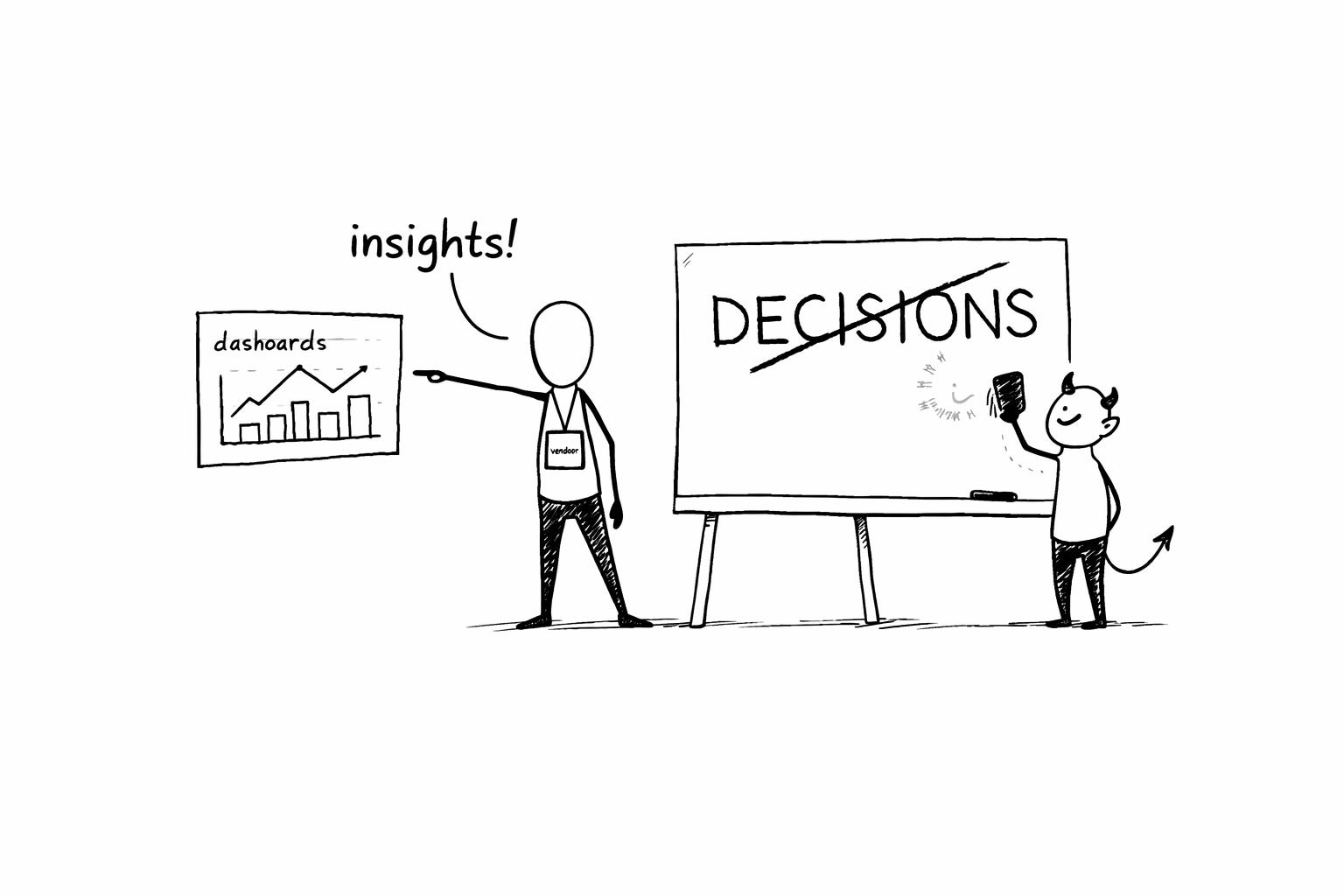
Sell “analytics” and you compete with Tableau, ThoughtSpot, Looker, Power BI, thirty startups, and the entire proxy economy. Sell “decision quality” and you compete with nobody.
The buyer isn’t the data team lead. It’s the COO. The VP of Ops. The CEO of a 200-person company who just realized they have no decision process — just a collection of dashboards nobody opens and a data team that processes tickets. The budget comes from a different line item. “We reduced decision cycle time by 40%” is harder to pitch than “we reduced dashboard creation time by 80%.” But the first one is what the CEO’s bonus depends on.
Gartner already has a category for this. No BI vendors compete in it. The few companies that do come from completely different lineages. This isn’t a crowded market with a new angle. It’s an empty market. Pitch the outcome: “Your leadership team made 47 strategic decisions last quarter. You have outcome data on zero of them. We make that number 47.”
(7) Design for disappearance, not for demos
Amazon’s WBR isn’t called BI. Dynamic pricing isn’t called AI. The more something actually works at making decisions better, the less visible it becomes. It just becomes “how we work.”
This is a product design principle. If your product looks flashy in a demo — beautiful dashboards, conversational AI, real-time visualizations — you’re probably building more proxy. The proxy is inherently visible, it’s designed to be seen. That’s why it gets funded, bought, and demoed.
Decision infrastructure is inherently invisible. When it works, nobody notices it. The WBR just happens. The PR/FAQ just gets written. The outcome review just occurs. You don’t demo water. If someone can look at your product and say “oh, that’s a BI tool,” you haven’t escaped.
(8) Force the thinking, don’t automate it away
Here’s what AI should actually do in this space. Not “conversational analytics,” not auto-generating documents. It should be the enforcement layer.
The point of AI is not to write the PR/FAQ for you. It’s to force you to write it. And yes, help you write it — by questioning you relentlessly. “What’s the expected outcome?” “How will you measure it?” “What’s your confidence level?” “What would make you abandon this decision?” The AI doesn’t reduce the cognitive work. It makes the cognitive work inescapable.
AI that won’t let you move to the next stage without answering the hard questions in writing. AI that surfaces what you should be asking during your WBR but aren’t. “You predicted 15% conversion. Actual is 9%. You haven’t discussed why in three consecutive reviews.” That’s not a dashboard. That’s an accountability engine.
A good decision intelligence tool won’t reduce the time an executive spends deciding. It will do the opposite. It will make a good executive spend almost all of their time making decisions — which is what they’re paid to do. And they only need a couple of great decisions in a given month to be worth gold. The tool that helps them make those two decisions 20% better is worth more than every dashboard their company has ever built.
Every vendor in that table uses AI to accelerate the production of charts. The opportunity is using AI to enforce the discipline that turns charts into decisions into outcomes into learning. That’s three steps past where anyone is building.
The founder from that Tuesday morning will read this. The executive from that afternoon might too. Both will agree with most of it.
That’s the thing about “we gotta make money today.” It’s not ignorance, it’s something closer to surrender. Every person who’s said it to me understood the proxy trap. They could name it. They could diagram it on a whiteboard. They just couldn’t see a way to make money from the fix.
And they’re right that it’s harder. Decision infrastructure doesn’t demo as well as a dashboard. The pitch is harder, the buyer is different, the sales cycle is different.
But the competition is also different. As in: there is none.
Thirty-plus vendors, tens of billions in combined market cap, thousands of engineers, all fighting over faster dashboards with AI. The market for actual decision infrastructure is empty. Not thin, not early. Empty.
The company that fills it won’t be called an analytics company. It probably won’t be called an AI company either. It’ll just be how good companies work.
Further reading (aka the hard work most people like to ignore):
Working Backwards - single best book on most of Amazons decision making processes. (Also see the Everything Store for additional notes). All of Jeff Bezos writing (being the one who set up tons of those processes) is great, for a comprehensive read, I suggest “Invent and Wander”
Ray Dalio’s “Principles” are another great piece of writing about systematic decision making (involving next to no data, albeit being the foundation that built the largest hedge fund in the world.)
P.S. I built a Substack stats extension I actually use. It’s free: Substack Enhanced Stats