

I was about to hire a BI analyst for MAIA.
It was on my next hiring plan. At Arch, I’d seen how valuable they were to product teams—Pat, our exceptional data engineer, showed me what good data analysis could do for decision-making. I wanted that same capability for my current team.
Then I started working with ChatGPT and MCPs on our database plus Appsmith.
That position got scrapped from the hiring plan faster than anything else.
Not because BI analysts aren’t valuable. Because ChatGPT could write the SQL, build the dashboard, and generate the insights in the time it would have taken me to write the job description. The $100k/year position I was planning became a $20/month subscription.
The BI vendors see this happening. And they’re panicking.
A couple of weeks ago, Tableau CEO Ryan Aytay announced Tableau Next with what he called “agentic analytics”—their repositioning as the platform where “AI is a collaborative decision-making partner.” The announcement claimed Tableau Semantics would serve as “the semantic layer that enables Tableau Next and Agentforce to have a unified understanding of business data.”
Then dbt Labs doubled down on their own desperate pivot, positioning their semantic layer as “AI-ready structured data” and claiming it would “unlock new data applications” and enable teams to “deliver consistent insights and AI at scale.”
I’ve managed both data teams and ML teams simultaneously. Here’s what actually happens: When a value-driven AI engineer or software engineer wants to push their AI product forward, they don’t wait for the data engineer to provide a “base layer.” They build it themselves.
Did the ML team tap into the data team’s infrastructure for quick prototypes? Sure. But when things went to production, the ML team had to work autonomously and fast. They couldn’t afford to wait for semantic layers, governance processes, or data team ticket queues.
dbt, you’re likely the infrastructure that will slow down AI development, not enable it. AI teams don’t need you. You need them.
Here’s what they’re not telling you: AI doesn’t need BI tools to function. BI tools need AI to justify their existence.
Tableau’s “AI-powered semantic layer” and dbt’s “AI-ready structured data” are the 2025 equivalent of “portal strategy” and “web-enabled.” These are phrases companies use when their core value proposition is dying and they’re scrambling to attach themselves to the next wave.
Here’s the BI Tool Death Watch pattern over the next 18-36 months:
Phase 1 (now): More “AI partnership” announcements as vendors claim they’re essential AI infrastructure. Watch for “agentic,” “semantic layer for AI,” and “enterprise-grade AI governance.”
Phase 2: First major layoffs at mid-tier BI vendors who couldn’t pivot fast enough. “Strategic restructuring” press releases that mention “focusing on AI capabilities.”
Phase 3: Acquisition wave begins. Salesforce consolidates or sunsets the legacy dashboard business. dbt pivots completely to data transformation or gets acquired by a data warehouse player.
Phase 4: “BI tool” and “semantic layer” become like “webmaster” and “portal”—things we remember from the past but would never call ourselves in a job interview.
You have maybe 18 months before tool expertise becomes a career liability instead of an asset. That position I scrapped? I still need the decision-making support. I just don’t need someone whose primary value is tool expertise.
The good news: This is the best thing that could happen to you.
Because BI tools diverged from the BI discipline years ago, and tool death means you’re finally free to do the real work again.
If you only have 5 minutes: here are the key points
AI is commoditizing technical data tasks like SQL writing, dashboard creation, and report generation—shifting value away from BI tool expertise.
BI tools are scrambling to stay relevant, repositioning themselves as “AI-ready” or “agentic,” but this reflects fear, not actual transformation.
The core of business intelligence—decision-making—remains critical, and is becoming more valuable as AI handles the technical layers.
Tool-focused roles and companies are at risk of obsolescence in 12–24 months unless they pivot toward decision support or infrastructure for AI.
BI professionals must reposition quickly: highlight business impact, not tool fluency; focus on the decisions influenced, not dashboards built.
Founders and leaders should reevaluate their products and teams to ensure they’re enabling better decisions, not just maintaining tools.
**The BI discipline isn’t dying—**it’s being freed from tool maintenance to focus again on what matters: judgment, strategy, and decision-making.
Why BI tool expertise is dying (but the discipline isn’t)

The critical distinction everyone’s missing: BI as a discipline and BI as a tool industry diverged years ago. Now AI is accelerating that divergence to the breaking point.
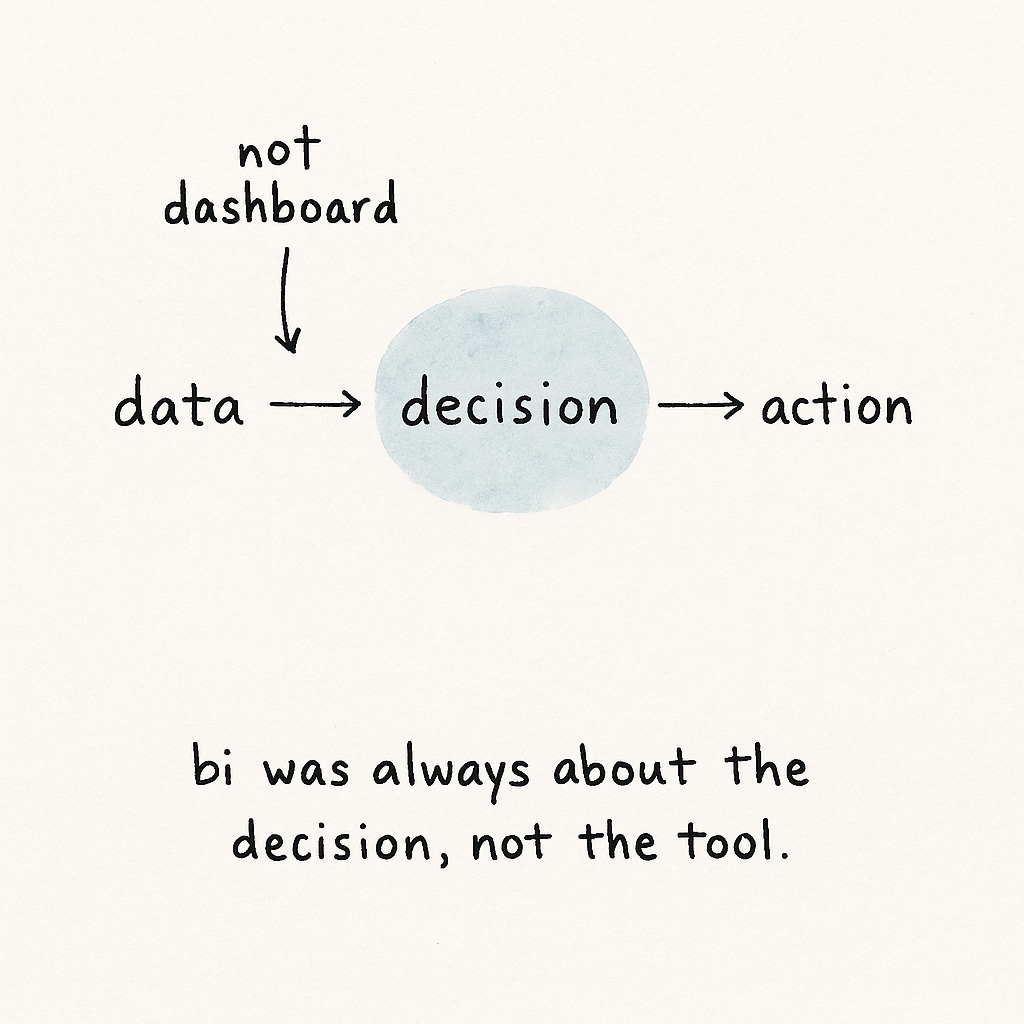
In 1958 (before the Internet!), Hans Peter Luhn at IBM defined business intelligence as “the ability to apprehend the interrelationships of presented facts in such a way as to guide action towards a desired goal.”
Notice what’s not in that definition: dashboards, SQL, reports, semantic layers.
BI was always about decision-making. That’s why Netflix, Airbnb, and CapitalOne became “data-driven”—not because they built better dashboards, but because they built systematic processes for making decisions based on data.
Then somewhere in the 2000s, BI tools became the thing. The industry redefined itself around software that could create dashboards. Microsoft and IBM now define BI as “software that ingests data and presents it in dashboards and reports.” They start with decision-making, then immediately collapse it into the tool. As if carpentry is defined by owning a hammer.
At Unite, I managed a BI platform for 700 users. We had brilliant analysts who spent their time writing SQL, building dashboards, maintaining reports. We measured success by dashboards deployed, query response time, data freshness.
When we talked to users: 90% never opened the dashboards we built. Not because the dashboards were bad—they were technically excellent. But dashboards weren’t the constraint.
The 90% needed help making decisions. The 10% needed help building dashboards.
We built tools for the 10% who create dashboards, not the 90% who make decisions. When you’re trapped in SQL maintenance and filter requests, you’re serving the tool. That’s what’s dying.
ChatGPT writes SQL. Claude builds dashboards. AI generates insights from data in seconds. The entire technical layer—SQL writing, data modeling, dashboard creation—is being commoditized right now.
But AI can’t tell you what decisions matter. It can’t tell you what to measure. It can’t tell you whether you’re asking the right question. That’s judgment. That’s the discipline.
When I stopped writing SQL 8 months ago and started using AI for all technical manipulation, I became 10x better at analysis. Not because AI made me faster at SQL—because it freed me to focus on “what should we measure?” instead of “how do I join these tables?”
The infrastructure shift pattern
Infrastructure shifts always kill the expertise industries built on old infrastructure. The internet didn’t need phone book expertise. Electricity didn’t need gas lamp expertise. AI doesn’t need BI tool expertise.
In 1998, logistics companies positioned themselves as “infrastructure for the internet.” They’d say: “The internet needs our distribution networks to function. We provide the infrastructure that enables e-commerce.” (seriously, “UPS advertised itself as “What can Brown do for e-business?” in 1999 & 2000.)
Technically correct—goods still needed physical distribution. But strategically backwards. The internet didn’t need logistics expertise to function. It just made distribution better.
Nobody remembers the companies that positioned themselves as “essential infrastructure for the internet.” We remember the companies that recognized the internet was general-purpose infrastructure that transformed everything.
Last week on LinkedIn, Roman Stanek (CEO of GoodData) posted about the shift from “AI for BI” to “BI for AI”:
“We thought AI would make BI smarter. Turns out, BI is making AI smarter. AI stopped being a helper and started becoming the reasoning layer itself. So the question isn’t how AI can make BI faster, but how BI can make AI smarter. BI becomes the context: definitions, governance, semantics, security that let AI act intelligently.”
I pushed back. Roman clarified: “BI will be augmenting the new agentic AI process.”
Roman is actively working to find GoodData’s place in the new world. The “data infrastructure for AI” positioning is smart—it’s better than Tableau’s approach of claiming “AI will make everything better” without changing their value proposition.
But here’s the pattern: “BI for AI” positions BI as something AI needs to function. Actually, AI is general-purpose infrastructure (like the internet) that’s transforming everything—including how we work with data and make decisions. AI doesn’t need BI to function. It just makes decision-making better, along with 1000 other things.
At Arch, Pat built perfect data infrastructure using Meltano. We could track every user action, every funnel step, every conversion point. I had dashboards showing real-time funnel performance, reports breaking down conversion by segment.
The most important numbers for steering GTM? I collected them in an Excel sheet once a week.
Not because the infrastructure was bad. Not because the dashboards didn’t work. But because making good marketing decisions required judgment about what mattered—which channels to focus on, which segments to prioritize, which experiments to run next. The Excel sheet forced me to think about decisions, not admire visualizations.
Infrastructure didn’t constrain good decision-making. My judgment did.
Here’s what’s getting commoditized vs. what’s getting more valuable:
Getting commoditized (AI does this in seconds): SQL writing, dashboard creation, data modeling, report generation, query optimization
Getting more valuable (AI can’t do this for now): Knowing which decisions matter, understanding what to measure, recognizing which questions are worth asking, business judgment about tradeoffs, strategic thinking about data collection
Staying the same: People still need to make decisions. They just don’t need you to write SQL for them anymore.
For practitioners
If you’re a BI analyst, data analyst, or anyone whose value proposition is “I’m good at [Tool Name],” you need to reposition before the market forces it.
This is a 6-12 month transformation. Week 1 is the first visible signal.
Look at LinkedIn profiles for high-paid data roles—they say “driving data-backed decisions” and “influencing business strategy.” Not “Tableau expert” or “Power BI specialist.”
I’ve seen this in hiring—decision-focused roles consistently pay 30-50% more than tool-focused ones. The differential isn’t because they know better tools. It’s because they focus on decision-making judgment, not technical manipulation.
Your Week 1 micro-repositioning takes under 2 hours:
Step 1: Change your LinkedIn headline (15 minutes)
From: “BI Analyst | Tableau Expert | SQL”
To: “Data Analyst | Helping [Company] make better decisions through data”
Or: “Analytics Professional | Turning data into business decisions at [Company]”
You’re signaling the direction you’re moving.
Step 2: Post one business decision you influenced (30 minutes), pick it up in your resume.
Not a dashboard you built. A decision someone made differently because of your analysis.
Template:
“This week I helped [team/person] decide [specific decision] by analyzing [specific data]. Result: [business outcome or expected impact].”
Example:
“This week I helped the product team decide to delay the new feature launch by analyzing usage patterns showing 60% of target users weren’t yet active. We’re now focusing on activation before releasing more features.”
This shows you care about decisions, not tools. It trains your network to see you as someone who drives decisions.
Step 3: In your next project, ask the decision question first
Before building anything, ask: “What decision are you trying to make?”
If the answer is “we need a dashboard to track X,” push back gently: “What will you do differently based on what the dashboard shows?”
The point is to start repositioning yourself as someone who cares about decisions first, dashboards second.
Week 1 is changing how you describe yourself. The full transformation takes months. But you need to start now. The people who reposition early will have the premium roles.
For tool builders
If you’re a founder, PM, or engineer building BI tools, you need to know whether you’re building for a dying market or whether you can pivot to something viable.
Week 1 isn’t about changing your product. It’s about gathering evidence that tells you whether you need to pivot now, while you still have runway.
You’ve been asking: “How’s the dashboard?” “What features do you need?” “Is the query performance acceptable?”
Those questions optimize for dashboard creators (the 10%) not decision-makers (the 90%).
Pick 3 customers you have good relationships with. Email them:
“I’m rethinking how we measure [Product Name]’s impact. Instead of asking about features, I want to understand what decisions you’re making differently because of [Product Name].
Quick question: What’s one business decision you made this month where [Product Name] influenced your choice? Not a dashboard you looked at—an actual decision you made differently.
15-minute call this week?”
Then run this 5-question conversation (15 minutes per customer):
“Walk me through the last business decision you made where you used our product.”
“What were you trying to decide?”
“What would you have done if you didn’t have our product?”
“What part of our product actually mattered for that decision?”
“What would have made that decision easier to make?”
If customers articulate specific decisions and describe how your product influenced them, you might have decision-making product-market fit. Focus on that, not feature requests.
If customers talk about dashboards they built but can’t articulate the decisions those supported, you’re serving the wrong persona. You’re building for the 1% who love dashboards, not the 99% who need to make decisions.
If customers struggle to answer at all, your current positioning probably doesn’t have a future in the AI-transformed landscape.
Based on those 3 conversations, you’re gathering evidence:
Can you pivot to data infrastructure for AI? If your customers care deeply about data quality, governance, and semantic consistency—and they’re using AI agents that need structured context—you might have a path as infrastructure.
Can you pivot to decision support? If your customers can articulate decisions but your current product gets in the way more than it helps, you might have a path as decision-making software. The Lovable.dev equivalent for business decisions—enabling the 99% to make data-driven decisions without the 1% building dashboards.
Should you double down? If your customers love your dashboards, want more features, and can articulate how those dashboards drive specific decisions, you might be fine. But be honest—this is rare.
Week 1 is gathering evidence. If it says you need to pivot, you have months to make that shift before you run out of runway. The vendors who recognize this pattern early have a shot. The ones who keep defending dashboard features will die.
For leaders
If you lead a data team, analytics team, or BI function, you need to know whether your team is trapped in tool maintenance or actually supporting business decisions.
Week 1 gives you the diagnostic.
Pick one dashboard request from your backlog. Instead of building it, schedule a 30-minute conversation with the requestor:
“Before we build this dashboard, I want to make sure we’re solving the right problem. Can we spend 30 minutes talking about what decision you’re trying to make?
If we can solve the decision problem without a dashboard, that’s better for everyone. If we do need a dashboard, I want to make sure it actually helps you decide.”
Then run this 4-question meeting:
“Walk me through the decision you’re trying to make.”
“What would ‘good’ look like—how would you know you made the right decision?”
“What information would actually change your decision?”
“If we could give you that information in any format, what would be most useful?”
If they can articulate a clear decision and describe what information would change it, build something focused on that decision. It might not be a dashboard—it might be a weekly email, a Slack alert, or a simple number they can check.
If they struggle to articulate the decision, the dashboard request is probably performative. They don’t actually need it—they just think data-driven companies are supposed to have dashboards.
If they want to “monitor metrics” without a specific decision tied to it, you’re about to waste 20-40 hours building something nobody will use.
Look at your team’s calendar for the past month. Categorize every project:
Tool maintenance: Dashboard bug fixes, “add this filter” requests, query optimization, report tweaks, data freshness issues
Decision support: Helping someone make a specific business decision, designing experiments to answer business questions, building decision frameworks, strategic analysis that changes business direction
If >30% of team time is tool maintenance, you’re trapped in the dying value proposition. This diagnostic tells you how urgent your team repositioning is.
One cancelled dashboard returns 20-40 hours of team capacity in the first week. But the real value is starting the shift of your team’s positioning from “dashboard factory” to “decision support function” before the market forces it.
The leaders who start this shift now will have decision-focused teams when AI makes tool-focused teams obsolete. Use Monday’s meeting to find out where your team is.
You respond, not the tools
The tools aren’t literally disappearing. Tableau will keep releasing features. Power BI will keep having conferences. But “I’m a Tableau expert” stops being valuable when AI can build the dashboard in 30 seconds.
What’s dying is tool expertise as your value proposition. What’s eternal is decision-making judgment.
P.S. I built a Substack stats extension I actually use. It’s free: Substack Enhanced Stats
Excellent analysis! The line about a $100k position becoming a $20 subscription perfecly captures the disruptive economic reality AI brings.
I agree with the general thrust of the article.
The only push back I have is on: "dbt, you’re likely the infrastructure that will slow down AI development, not enable it." My thinking here is that a lot of these AI agents, at least right now, need a text/code-based representation of the world to work with. Sure an agent can query the schema and write some SQL, but there's a ton of context it would do well to have stored in tools like dbt.
That said, I don't know how well Codex / Claude Code would work with dbt Cloud or any other SaaS offering, so maybe you're right here.