

Carolin, our CEO, was on stage at our company all-hands, doing the usual leadership cadence: wins, misses, priorities.
Then Nico stood up.
Nico is a sales rep. Not “data-driven” in the way LinkedIn posts mean it. More like… pragmatic. Fast. Impatient. The kind of person who will happily run a business on gut feel, if the alternative is waiting two weeks for a dashboard.
He plugged his laptop in.
On the big screen: a dashboard titled something like “Churn Risk — This Week” (he didn’t workshop the name, obviously). Customers listed row by row. Next to some names: a flashing red “+”.
It was obnoxious.
It was also perfect.
Each flashing red plus meant: this account is about to churn — and right beside it was everything you’d need to do something about it: last order date, ticket volume, product usage collapse, segment tags, owner notes, contract size. Not “insights.” Actionable ammunition.
Carolin squinted at the screen, then turned to me:
“Nico… did you suddenly learn how to code?”
Nico didn’t learn to code.
Nico learned something more dangerous.
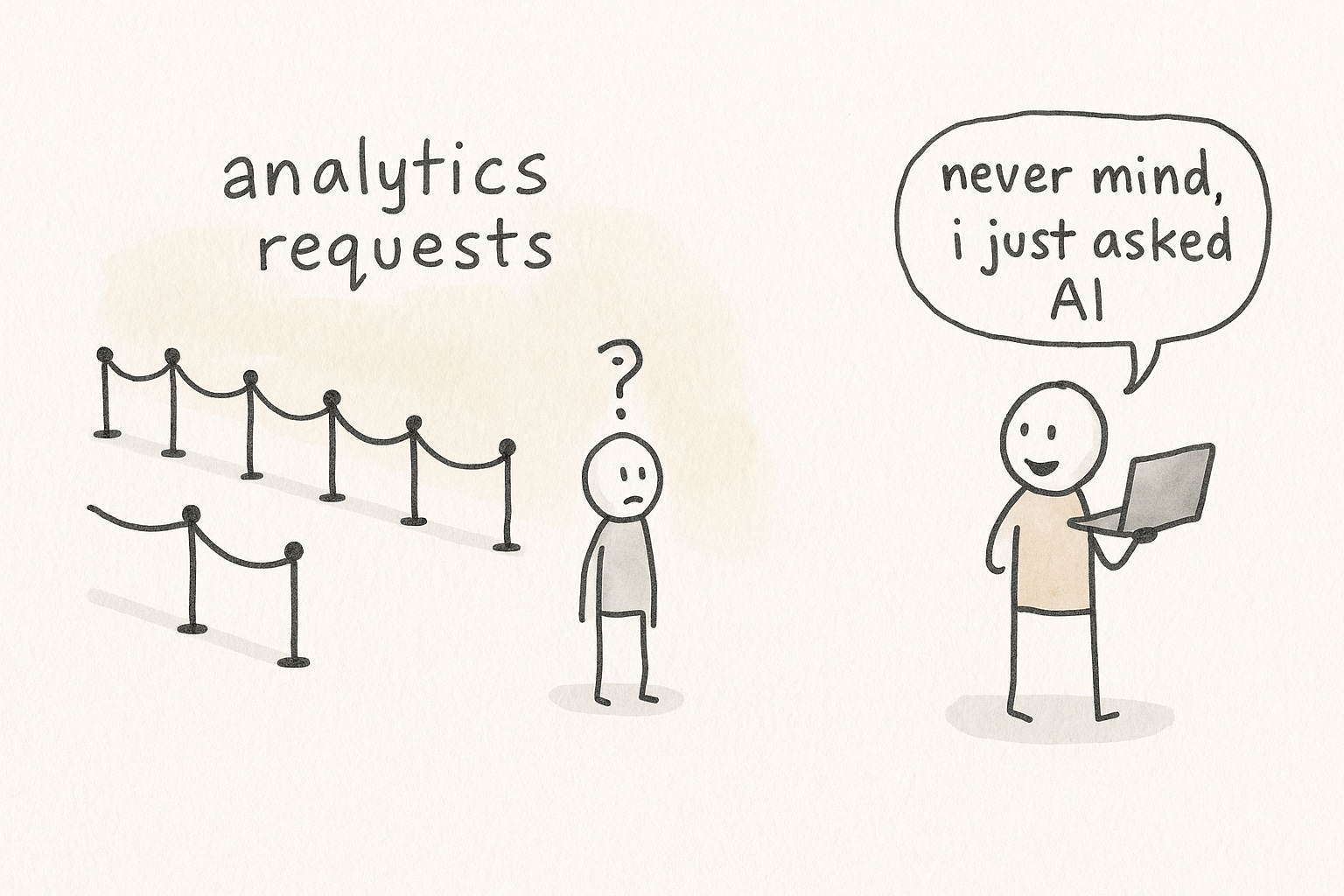
He learned that the analytics team is optional.
Because three months earlier, Nico’s workflow looked like this:
Nico: “Can I get a dashboard for accounts likely to churn?”
Analytics: “We’re swamped. Maybe next quarter.”
Nico: goes back to Excel, vibes, and praying.
Now he built it himself in 15 minutes.
Not because he’s a wizard.
Because he did what everyone is doing right now, quietly: he connected a schema to an AI tool and stopped waiting.
And here’s the part nobody wants to say out loud:
If your analytics team’s core function is translating business questions into SQL, dashboards, and recurring reports… you are funding a role whose economic foundation just collapsed.
Not next year.
Not “once governance catches up.”
Already.
So yes — this article is, in practice, a guide for CEOs to do something uncomfortable:
Cut the analytics queue. Keep the judgment. And move on before your board forces you to do it badly.
If you only have 5 minutes: here are the key points
AI has made traditional analytics queues obsolete: Business users like product managers and sales reps are now using AI tools to answer their own data questions instantly—without waiting on analytics teams.
80% of analytics roles are vulnerable: Roles focused on translating questions into SQL and maintaining dashboards are being replaced by AI-powered self-service.
The elite 20% are more valuable than ever: Analysts who deeply understand the business, use AI fluently, and shape strategic decisions are becoming 10x more impactful.
Restructure or risk blunt cuts: CEOs and leaders must proactively identify top talent, embed them into business teams, cut queue management layers, and invest in AI tooling.
The payoff is speed and cost-efficiency: Decision velocity increases dramatically, costs drop, and strategic iteration accelerates—despite some growing pains like metric drift and lost institutional memory.
The analytics queue was never a strategy — it was a patch
The modern analytics team exists because companies had a gap they didn’t know how to bridge.
A decision-maker has a question:
“Which customers are likely to churn?”
“Why did activation drop last week?”
“What changed in retention by cohort?”
But they can’t answer it. Not because they’re stupid. Because answering it used to require:
knowing where the data lives
knowing what tables mean
knowing SQL
knowing BI tools
knowing how not to lie to yourself with metrics
So we invented a system: the analytics queue.
And we staffed it with people whose job is basically: translation.
Business question → SQL → chart → interpretation → meeting → decision.
The problem is that translation has an ugly property:
It doesn’t scale.
It creates waiting.
And waiting destroys decisions.
In the old world, that was still tolerable because the alternative was nothing. You couldn’t just hand a PM the database and say “go explore.” They’d break things and then blame you.
So the queue stayed.
And the industry built religion around it: governance, rigor, centralized truth, semantic layers, certified dashboards, KPI catalogs, metrics stores, “single source of truth” decks that are mostly aspirational fiction.
Then AI showed up and did the one thing you weren’t allowed to admit was the majority of the job:
It learned to translate.
AI didn’t kill analytics. It killed analytics middlemen.
Let’s separate two things that companies keep confusing because it’s convenient:
Execution work vs judgment work.
Execution work is: write SQL, maintain dashboards, rebuild reports, answer tickets, format charts, re-run queries, export CSVs, stitch metrics together, “quick analysis for tomorrow’s meeting,” etc.
Judgment work is: decide what matters, define metrics that don’t rot, interpret shifts correctly, generate hypotheses, design experiments, call out bullshit, prevent people from optimizing the wrong number, and connect data to business reality.
AI is eating execution work alive.
And it’s doing it in the most humiliating way possible: not by being “better,” but by being fast enough that people stop asking permission.
A PM types:
“Show weekly active users by acquisition channel for users who signed up in Q1.”
They get working SQL.
They paste it into their tool.
They get a chart.
They move on.
No ticket. No queue. No “can you prioritize this.” No analytics standup.
Decision time collapses from 11 days to 90 seconds.
If you’ve ever run a data org, you know what happens next: the official process stays intact on paper, while the real work moves around it.
People don’t announce it. They just… stop filing tickets.
And yes, your analytics team sees it happening.
So they do what humans do when they feel the ground moving under them:
They lean on the sacred language.
“Self-service is dangerous.”
“Without governance we’ll get metric drift.”
“We need statistical rigor.”
“We can’t let people query production.”
All true, by the way. But also a smokescreen.
Because none of those arguments answer the real question:
What are you paying 8 people for if the business can get 80% of the answers on its own?
Most analytics teams are 80% translators and 20% strategists
I ran a BI platform for roughly 700 users.
Brilliant analysts. Technically excellent work. Clean dashboards. Good SQL. Correct joins. Fresh data. Great documentation (for the two people who read it).
We measured the usual things: dashboard adoption, freshness, performance, number of deployed dashboards, number of tickets closed.
Then we asked users what actually helped them.
And 90% of them didn’t open the dashboards.
Not because dashboards were bad.
Because dashboards weren’t the constraint.
Most people don’t need “a dashboard.” They need:
a decision
a recommendation
a sanity check
a short list of plausible causes
the confidence to act
Dashboards are built for the 10% who already know what they’re doing and want a monitoring cockpit.
Most organizations keep building for the 10% because it’s measurable, fundable work: “we shipped a dashboard.”
But the real value — the reason you hired analytics in the first place — is the part that isn’t easily counted:
judgment.
So here’s the pattern I keep seeing:
80% of the team is doing queue work (translation + delivery)
20% of the team is doing judgment work (decision support + strategy)
AI is making the 80% redundant.
And it’s making the 20% terrifyingly powerful.
The best analysts become 10× better not because they write SQL faster, but because they stop spending their attention on execution and spend it on thinking.
That changes what your company should optimize for.
You don’t want more translators.
You want fewer, better judgment holders — embedded close to the decisions — and tools that let everyone else self-serve the routine stuff.
Five questions that expose who you must keep
This is the part CEOs avoid because it feels like “culture.” It’s not culture. It’s cost structure.
If you restructure wrong, you lose the only capability that matters and keep the wrong people because they were busy and visible.
So don’t guess. Use filters.
Here are five questions that separate judgment holders from queue managers.
1) Do they generate hypotheses before touching data?
When conversion drops, do they immediately say:
“Probably onboarding, pricing page, or channel mix,”
or do they ask:
“What exact query do you want me to run?”
2) Is AI invisible in their workflow?
I don’t mean “they tried ChatGPT once.”
I mean: you hand them a messy business question and execution just… happens.
Draft plan. Query. Breakdown. Caveats. Next steps.
No drama. No ceremony.
3) Are they decision-proximate?
Do they sit in product planning? Marketing reviews? Ops postmortems?
Or do they show up at the end with a chart?
If they don’t know what decisions are being made, they’re not analysts. They’re data technicians.
4) Do they define what should be measured?
Do they come back with frameworks: leading vs lagging indicators, segmentation logic, “this metric will be gamed,” “this definition will drift,” “this is noisy”?
Or do they wait to be told what metric you want?
5) Will they tell you you’re wrong?
This is the big one.
You don’t need eight people who agree with you and can format charts.
You need one or two people who can say:
“That’s a comforting story. The data doesn’t support it.”
That’s your elite 20%.
The rest aren’t bad people. They just occupy a role that AI is devouring.
The only restructuring that actually works
There’s one viable path through this shift. And you can’t half-do it.
If you only cut headcount, you’ll create chaos.
If you only buy tools, you’ll keep the same bottleneck with shinier UI.
If you only keep the elites but keep the queue, you’ll never get the leverage.
You need all three moves together.
Move 1: Kill the central analytics queue.
Stop treating “analytics” as a service desk.
The service model creates wait times, and wait times destroy decisions.
Move 2: Concentrate your judgment holders.
Keep 2–3 truly senior analysts (however many you actually have).
Embed them directly into product, marketing, and ops.
Their job is not “answer tickets.”
Their job is: make the organization harder to fool.
They own:
definitions
metric integrity
experiment sanity
narrative quality
decision velocity
Move 3: Spend the savings on leverage.
Buy (or build) whatever makes self-service actually work:
safe query access
semantic layer where it helps (not religion)
AI-assisted analytics workflows
guardrails, templates, reusable patterns
Let the PM type:
“Why did signup-to-activation drop last week?”
…and get a credible first answer in minutes.
Not perfect. Credible.
Then the elite analysts do what only humans with context can do:
stress-test the interpretation, prevent mistakes, and guide the actual decision.
“But what about governance?” Yes. Things break. Here’s the real trade.
Three things improve immediately:
Decision velocity jumps because the queue disappears.
Exploration explodes because asking becomes cheap.
Cost structure flips from linear output to leveraged output.
Now the honest part: three things genuinely get worse if you’re sloppy.
Metric definition drift.
Marketing calls “activation” one thing. Product calls it another. Six months later you’re arguing about whether activation is up or down, and everyone is technically correct.
Statistical rigor decay.
Someone runs an A/B test on 47 users and declares a 12% lift. Congrats — you invented noise-driven strategy.
Institutional memory loss.
The analyst who remembers why Q3 2019 looked weird is gone. Now you spend hours rediscovering something that used to take 30 seconds to explain.
So no, I’m not selling a utopia.
I’m saying something more annoying:
These risks are easier to manage with 2 elite analysts than with 8 mixed-capability ones.
Because mixed teams create a false sense of safety.
And the queue creates a false sense of rigor.
The elites catch drift because they know which definitions matter and why.
They catch statistical stupidity because they understand business mechanics.
They preserve institutional memory by being embedded where it’s used, not stored in dashboards nobody opens.
Your board is going to ask why you’re paying for an 11-day answer
Here’s what will happen over the next 12–24 months in most companies:
The business will quietly self-serve routine analysis.
The queue will get slower because ticket volume drops but complexity rises.
The analytics team will defend itself with governance rhetoric.
The board will notice the cost and ask why decision velocity still sucks.
If you wait, you don’t get a careful restructure.
You get a blunt cut:
“Reduce G&A by 30%.”
And blunt cuts destroy the only thing you needed: judgment.
So if you’re a CEO, the correct move is not “fire analytics.”
The correct move is:
Fire the queue model.
Keep the judgment.
Build leverage.
That’s how you get the same strategic capability with triple the speed and half the cost.
Questions to answer on Monday morning
No philosophy. Just look.
1) What percentage of analytics requests are basically “build me a dashboard showing X”?
If it’s more than 50%, you’re paying for translation.
2) Which dashboards from last quarter are still opened weekly?
If fewer than ~30%, you’re building artifacts, not decisions.
3) Who can produce three plausible hypotheses before touching data?
That number is roughly how many analysts you actually need.
4) Who in product/marketing has stopped filing tickets?
Those are your “Nicos.” The shift is already underway.
5) If your analytics team vanished tomorrow, what would truly break?
Not what would be annoying. What would be strategically dangerous.
Write the answers down.
Then restructure deliberately — before someone else forces you to do it badly.