

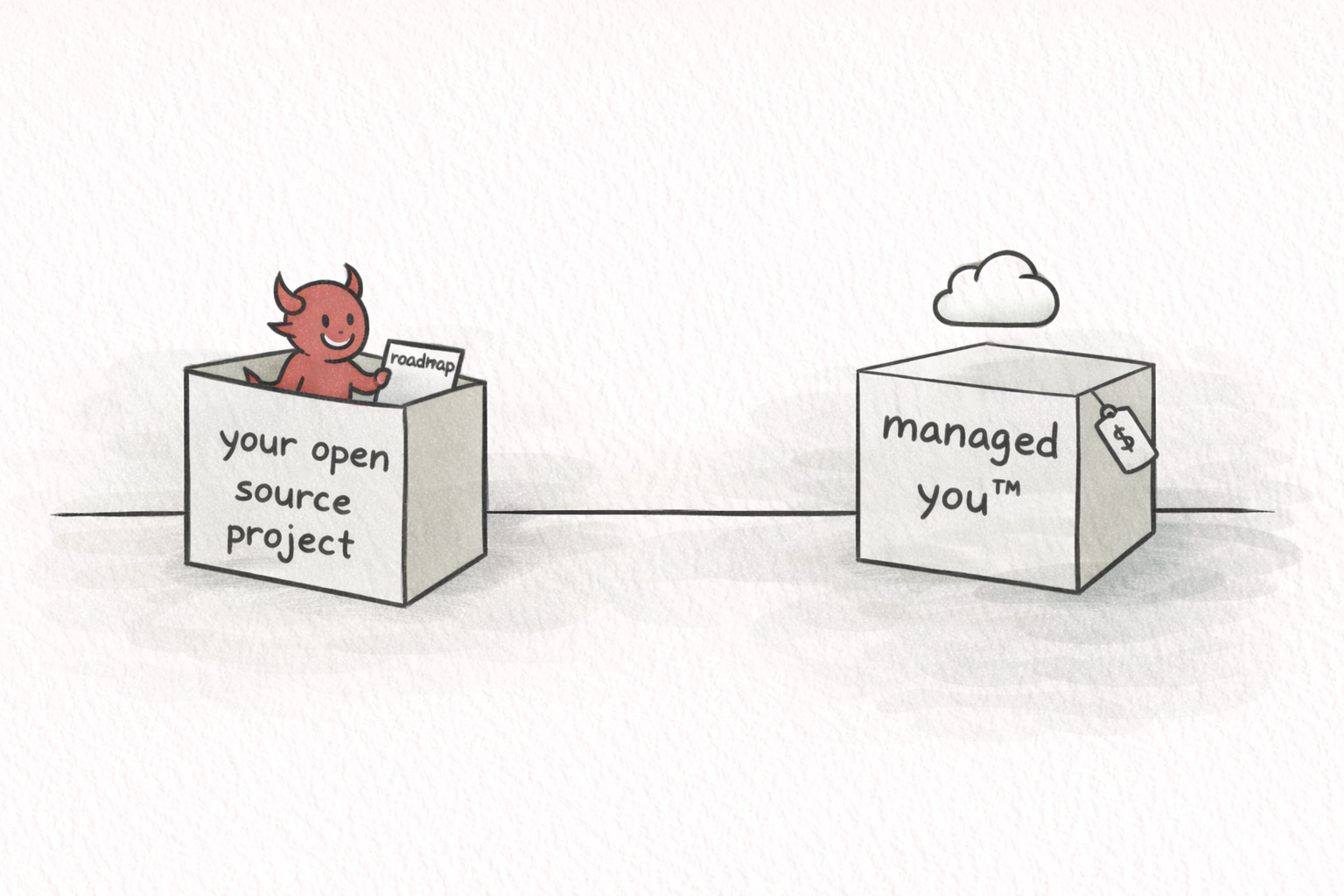
Monday, 08:12.
A cloud giant announces Managed YourProject™.
Same API. Same docs. Same migration path.
Different logo. Different margins.
By Friday, half your inbound turns into one question:
“Why wouldn’t we just use the managed one?”
Here’s the adult version of open source:
Open source isn’t ideology. It’s competitive strategy.
A permissive license isn’t a virtue. It’s an invitation.
And yes — the “community outrage” pattern is real. But it’s messy:
Sometimes the backlash is authentic. Sometimes it’s authentic and strategically amplified.
Note: Today we’ll be doing something different, this is a tactical, immediately actionable piece, with all the meat and none of the fat. Enjoy, it’ll be a quick (but hopefully very valuable) read.
The OSS War Doctrine
Here is what it really looks likes to me:
Code spreads. Interfaces trap. Brands endure.
Open what spreads. Close what earns.
Assume the fork is coming — build what it can’t copy.
The 7 tactics cheat sheet
OS warriors have 7 moves to fight this, prevent this, use this:
ATTACK (steal distribution):
Fork + out-resource the original
Implement their API, not their code
Commoditize the lock-in layer
DEFEND (make “Managed You” expensive):
Switch licenses before hyperscalers care
Weaponize authenticity (the fork can’t buy “original”)
BUILD (create compounding moats):
Hook developers free, gate what enterprises require
Give away what spreads, keep what earns
If they ship “Managed You” this week do this within 72 hours
Message (everywhere): “We’re the original authors. We control the roadmap. We’ll be here in 5 years.”
Publish: Fork FAQ (compatibility claims, roadmap diffs, trademark boundaries, migration reality)
Publish: 2-release fork-proof roadmap (SSO/audit/control-plane/integrations — pick what they can’t ship fast)
Publish: “We are the source” landing page (maintainers, governance, enterprise plan, customer logos, security posture)
Do: trademark everything you can today
Do: pre-brief top customers so they don’t learn your story from the competitor
The 3 questions that decide any OS strategy today
What will they copy first: your code, your API, or your distribution?
What can you ship that a fork can’t in 6 months?
What enterprise requirements do you own (that devs don’t care about)?
Now the playbook.
ATTACK
Win their market without writing their code
1) Fork + out-resource the original
The play: Fork under the permissive license and fund momentum until your fork becomes the default.
Your move:
Fork fast. Speed beats elegance.
Win the narrative: “We’re keeping it open.”
Ship the neglected pain: the feature requests they “couldn’t prioritize.”
Recruit frustrated contributors (names create legitimacy).
Case file: AWS → Elasticsearch → OpenSearch
Elastic changed licensing to stop hyperscalers reselling Elasticsearch as a managed service. AWS forked, shipped its own distribution, and marketed it as the “true” open alternative. Then came the credibility move: “neutral governance” optics + ecosystem logos + momentum.
Quick nuance:
Foundations are instruments: sometimes they produce real neutrality, sometimes they produce neutral-looking governance.
Also: OpenTofu vs Terraform
Terraform moved to BSL → coalition forked to OpenTofu → foundation backing → shipped long-requested improvements quickly. Same mechanic, different scale.
Note: HashiCorp still “closed what earns” and earned a 6.4 billion USD acquisition.
2) Implement their API, not their code
The play: Copy the interface. Skip the license. Capture the ecosystem.
Your move:
Identify the interface moat (wire protocol, API, SQL dialect, plugin contract).
Rebuild compatibility on your infrastructure.
Market it plainly: “Works with X.”
Compete on leverage: scale, cost, distribution.
Case file: DocumentDB vs MongoDB
AWS didn’t need MongoDB’s code. It needed MongoDB’s shape. Implement the protocol, inherit drivers + tutorials + mental models, and customers migrate without rewriting.
3) Commoditize the lock-in layer
The play: Don’t fight the incumbent where they’re strong. Remove the thing they’re strong at.
Your move:
Name the lock-in layer (orchestration, data format, workflow contract).
Open-source (or champion) a standard that breaks the trap.
Wrap it in legitimacy (foundation / neutral branding).
Then compete above the standard.
Case file: Kubernetes
Standardized orchestration weakened pure infrastructure lock-in. AWS still won plenty — but it was forced to support the standard because customers wanted optionality. The board changed.
Micro case file: Iceberg vs proprietary table formats
Open table formats made storage + compute more interchangeable. The moat moved from “we own your data layout” to “we own your ecosystem and execution.” Standards don’t kill incumbents — they relocate the fight.
DEFEND
Make “Managed You” legally and commercially expensive
4) Switch licenses before hyperscalers care
The play: Start permissive to spread. Switch once you’re valuable — before the giants arrive.
Your move:
Decide your endgame early.
If you’re growing, change licensing before you’re worth forking.
Frame it as protecting contributor investment and sustainability.
Assume a fork is coming anyway; plan around it.
Case file: Airbyte (early switch, low backlash)
Airbyte tightened licensing early while keeping the protocol open — standard stays free, resale gets blocked, business stays viable. Early = strategy.
Note: Another point in my case that the founders of Airbyte are hiding their unnatural talents in OS warfare.
Case file: Redis → Valkey (late switch, instant fork)
Redis changed after years of expectations. Hyperscalers forked quickly. Late = revolt + permanent fork energy.
5) Weaponize authenticity (the fork can’t buy “original”)
The play: The source matters. Treat it like a moat.
Your move:
Trademark everything that matters.
Make “original authors” a product feature — repeat it everywhere.
Build direct customer relationships before marketplaces capture them.
Ship integrated advantages forks can’t match (hosted control-plane, managed scale, proprietary integrations).
Case file: MongoDB vs DocumentDB
DocumentDB copied compatibility. MongoDB keeps winning higher-stakes buyers by leaning on “we are the source,” roadmap authority, long-term accountability, and a managed platform story.
Case file: Elastic vs OpenSearch
Originals can keep winning if they ship faster, market “source of truth,” and bundle differentiated capabilities forks can’t replicate cleanly.
BUILD
Turn open source into compounding leverage
6) Hook developers free, gate what enterprises require
The play: Make adoption frictionless. Gate compliance, governance, and scale.
Your move:
Make starting stupid-easy: no sales call, no demo, no “talk to us.”
Gate what enterprises require:
SSO / SAML / SCIM
audit logs & retention
encryption / key management
compliance packages
disaster recovery
support SLAs
Instrument the funnel: individual → team → production → enterprise.
Case file: MongoDB’s funnel logic
Developers adopt because it’s easy. Teams standardize because it works. Enterprises pay when governance/compliance/security becomes mandatory.
7) Give away what spreads, keep what earns
The play: Open-source what creates dependency. Keep what captures value.
Your move:
Open-source: standards, SDKs, client libraries, tooling, reference implementations.
Keep proprietary: infrastructure, management plane, hosted scale, enterprise governance.
Make your paid product the default for anyone who adopted the standard.
Case file: Cloudflare (open the tool, keep the machine)
Cloudflare can open-source serious infrastructure components and still win because the real moat is the network + operations. The open piece spreads patterns. The closed piece prints money.
Checklist (think about this now)
What will they copy first: code, API, or distribution?
What can we ship that a fork can’t in 6 months?
Which enterprise requirements are we deliberately gating?
What standard do we want the ecosystem locked into?