

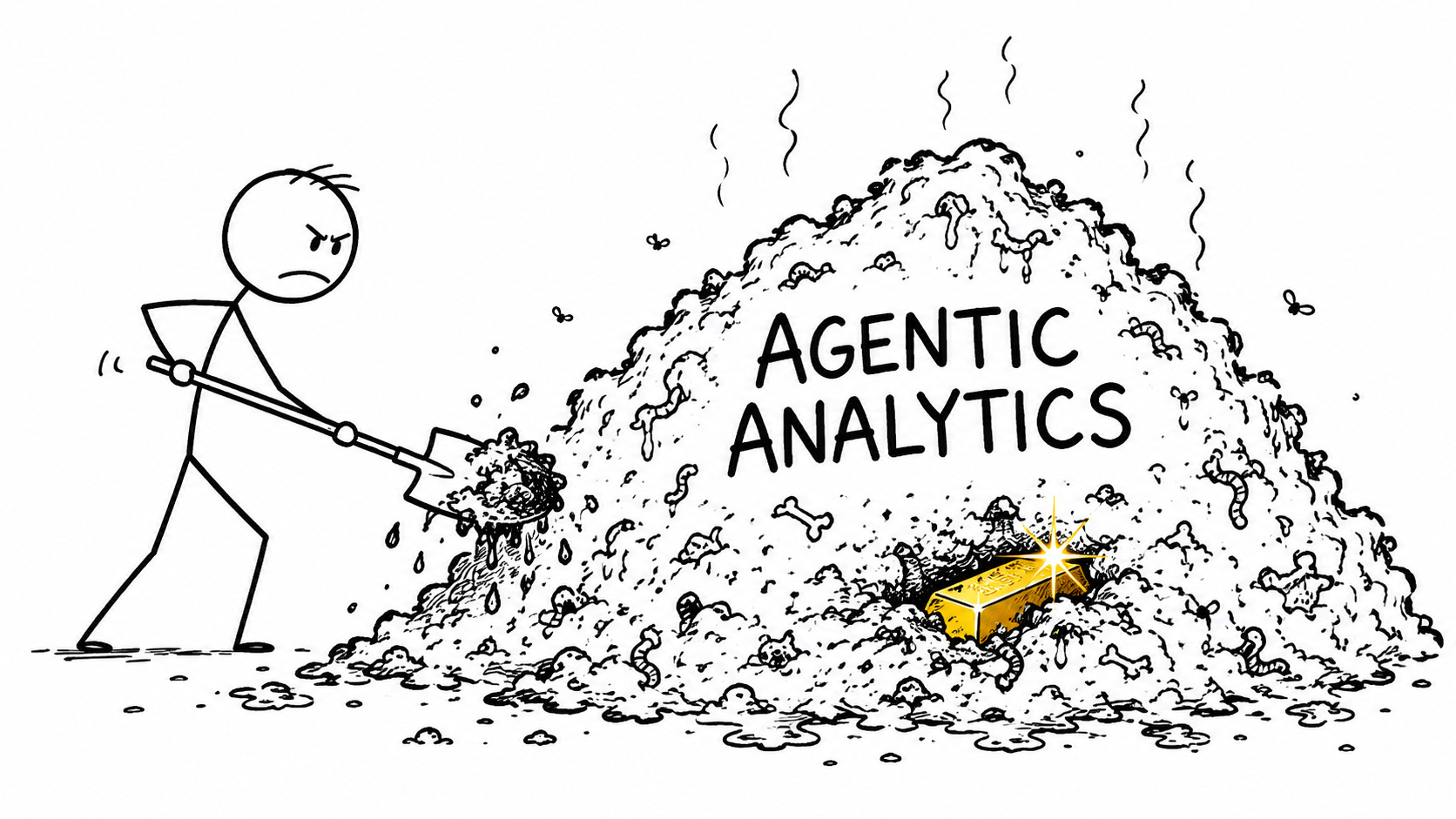
Boy, is there a lot of shit floating around “agentic analytics.”
Nobody woke up asking for it.
It is the phrase you get when every BI platform, dashboard vendor, copilot, semantic-layer company, and embedded analytics product needs to sound inevitable in 2026.
But buried inside the repackaging is the thing data software kept promising and never delivered: action.
What it is not: a chatbot for your dashboard.
What it could be: a system that watches the business, spots what changed, explains why, and pushes the next action into the workflow where the work already happens.
Why that matters: for twenty years, data software promised action and mostly delivered places to look.
Agentic analytics is the first serious swing at fixing that.
1. The real prize is not dashboard chat. It’s the Capital One machine
Thirty years before anyone said “agentic,” Capital One built the machine every platform vendor is now pretending to sell.
In 1987, two consultants, Richard Fairbank and Nigel Morris, pitched a then-insane idea: instead of charging every credit-card customer the same ~20% rate, use data to test thousands of offers and match each one to the person. Roughly thirty banks said no. A small Virginia bank, Signet, said yes in 1988, and the division spun out in 1994 as Capital One, now the largest card issuer in the United States.
The engine was boring: tens of thousands of pricing experiments a year, segment everyone, predict who’s leaving, decide the next move for each person.
Test, learn, personalize, act.
That last word is the whole point.
For thirty years, running that machine meant being Capital One, or Amazon, with the armies of analysts and infrastructure to match. Recommendations, segmentation, churn, next-best-action: the crown jewels of the elite data companies, and almost no one else’s.
That is what the agentic analytics copy is really promising. Not “ask your dashboard a question.” Not “chat with last quarter’s revenue.” A system that notices the customer is drifting, knows which offer might save them, pushes the next action to the right person, and learns from what happened.
That is exciting as hell.
And it is also where most of the current product category falls apart. The marketing copy points at the Capital One machine. The shipped product often stops at dashboard chat with better autocomplete.
And this is where the bullshit lives. What’s moving the real numbers is the Capital One lineage: models, experimentation, and a decision layer. McKinsey has next-best-action cases cutting churn intention by 59%; newer operators report 30% churn drops and 50% lifts in lifetime value. Treat the exact numbers carefully, but the direction is clear: the machine is leaking out of the elite tier.
The capability is real. The vendor slide mostly isn’t.
But the direction is unmistakable. The machine that took Capital One a decade and an army to build is becoming cheaper, more packaged, and more reachable.
Not solved. Reachable. And that is enough to matter.
2. Anthropic proved the model was not the bottleneck
The prize is real. The cleanest proof you can reach it comes from Anthropic.
They handed their own analytics to Claude: about 95% of internal business-analytics questions are now self-served, at roughly 95% accuracy.
The number that matters, though, is where it started. Out of the box, pointed at the warehouse, Claude never cleared 21% accuracy. And the part every demo skips: feeding it every existing query and dashboard the company had moved accuracy less than a point. Access wasn’t the bottleneck. Structure was. What dragged 21% to 95% was the scaffolding around the model, governed data, a semantic layer it’s forced to consult, validation, not the model itself.
And it decays. Ease off the upkeep and accuracy slid from 95% back to 65% in a month. This is not a thing you install. It’s a thing you feed and maintain.
Self-serve now can work at real volume.
3. easyJet shows where the value actually lands
easyJet Holidays is the messy but useful version of the story.
Messy because this is ThoughtSpot material, not a neutral lab study. Useful because even through the vendor fog, you can see exactly where the value lands.
Within months, easyJet Holidays had rolled the AI analyst out to roughly 350 of its 400 employees, with about 100 people querying it every day. Revenue roughly doubled, from ~£500M to ~£1B, while the data team grew only from five to ten.
Do not read that as “ThoughtSpot doubled revenue.” A travel business roared back, and easyJet Holidays rode the wave. The tool did not create the wave. What it did was let the business ride it without tripling the data team.
But here’s the part I noticed: easyJet’s trading managers used to fly to Greece to negotiate with the big hotel chains, carrying decks built from twelve months of booking data. Now they run those negotiations live, on their phones, asking the questions as they come up across the table.
The analyst stopped being someone you queue behind and became something you hold in your hand mid-conversation. That is not the Capital One machine yet. Every query is still mostly “give me an answer,” not “the agent did the thing.” Still self-serve. Still not autonomous action.
But now the value is in the room where the decision happens.
And the quiet detail matters most: this did not work because someone bolted a chatbot onto a dashboard. It worked because the data team had already built the semantic models and business context the AI analyst could run on.
The value landed with the doer. The precondition was paid by the data team.
4. This gets huge when analytics leaves the company
This is the part that excites me most.
Inside one company, agentic analytics is useful. A trading manager asks better questions. A support lead spots churn earlier. A finance team catches variance faster. Great.
But the real multiplier starts when that capability stops being internal software and becomes something a company ships to its customers.
That is what embedded agentic analytics changes.
Analytics used to be an internal good: you built it for your own people, so they could look at your own numbers. Now the same capability that lets your staff self-serve can become part of the product itself. ThoughtSpot’s embedded version promises to drop the agent into your product in weeks, instead of the 12–18 months it would take to build yourself. Navan embedded it so customers can ask, in plain language, where their travel spend went.
That is a much bigger idea than “chat with your dashboard.”
It means the Capital One machine does not just leak from elite data companies into normal companies. It can leak through normal companies into their customers.
Every vertical SaaS product. Every marketplace. Every fintech. Every logistics platform. Every workflow tool sitting on valuable customer data suddenly has a path to ship data value directly into the customer’s work.
But: the poster children are platform-shaped companies that already had the data layer standing first. Real wins, but pre-selected ones.
Still, the math is the whole point. Take the value agentic analytics creates inside one company, and multiply it by that company’s entire customer base.
That is when this stops being a better BI feature and starts looking like a much bigger data market.
This is why the market breaks three ways
Now count what all those examples had in common.
None of them worked because the agent was magic. They worked because the context layer underneath was already there: trusted data, governed metrics, semantic models, permissions, workflow access, feedback loops, maintenance. The boring stuff, the stuff nobody puts in the keynote, because it ruins the magic trick.
And that creates three problems, not one.
The first is the buyer problem: the people who get the value, easyJet’s traders, the ops lead, the support manager, the sales manager, are exactly the people who can’t deploy the full thing. No warehouse keys, no semantic layer, no authority to wire an agent into the business. They want it; they can’t build it.
The second is the DIY problem: the people who can deploy it, the data team, whoever owns the warehouse, the metrics, the permissions, may not need to buy much of the agent layer at all. Once the context layer exists, the agent on top is the easy part. Anthropic just proved the model was never the bottleneck.
The third is the bypass problem, and this is the one that should scare data teams most.
Look back at easyJet. If I’m a head of product, or sales, or support, I do not necessarily experience that as “I need a central data strategy.” I experience it as: my team needs better answers in the moment of work. My traders need the phone in Greece. My account managers need the churn signal before the renewal call. My support leads need the angry-customer pattern before the escalation.
And if the central data team is slow, I am not going to wait.
I will buy a vertical tool. I will ask my product ops person to wire something together. I will take the startup that solves my narrow problem this quarter. It will not be perfect. It will not be coherent. It will not have the company-wide context layer. But it will solve enough of my local pain to keep moving.
That is the awkward market shape.
The vendor wants to sell around the data team, but often has to pitch to the data team.
The data team can deploy it, but may build enough of it themselves.
And the doer who actually feels the pain may skip both of them and buy a narrow workflow tool instead.
That’s not a value problem. The value is obvious.
It’s a distribution problem, a buyer problem, and a power problem all at once.
The turn nobody on stage wants to take
All three problems point to the same place. But not in the comforting way data teams want.
Strip the demo away and the agent is not the scarce part. Anyone can call an LLM. What decides whether agentic analytics actually works is the layer underneath: the trusted data, the governed metrics, the semantic models, the permissions, the validation, the maintenance.
That is the product, the moat, and the gatekeeper, all at once.
And in most companies, the only team with a credible claim to own the coherent version of that layer is the in-house data team.
Which means the thing the entire industry is racing to sell is load-bearing on the team the entire industry keeps writing obituaries for.
The data team isn’t being killed by agentic analytics.
The coherent version does not work without it.
The scariest version is that the bypass works
That is not a victory lap.
The comforting story for data teams is that agentic analytics needs one coherent context layer, and the data team owns that layer, so everyone has to come through them.
Maybe.
But look at what actually happens inside companies.
Sales does not wake up wanting a governed enterprise context layer. Sales wants the pipeline-risk agent before the quarter slips. Support wants the churn signal before the angry customer escalates. Finance wants the variance explanation before the board pack. Product wants the feedback pattern before the roadmap meeting.
And a lot of those problems are local enough to solve locally.
Not perfectly. Not universally. Not with some beautiful central architecture. But well enough. A vertical tool, a product ops person, a RevOps workflow, a support platform with an agent inside it, a startup that knows the function better than the central data team ever will.
That is the scary version.
Not that the fragmented path fails.
That it works.
It works well enough for the business to stop waiting. It works well enough for functions to buy their way around the queue. It works well enough for startups to wedge themselves into every operational workflow with their own context, their own permissions, their own definitions, and their own version of “good enough.”
That is what data teams keep missing.
The central layer was never as necessary as data people wanted it to be. Or rather: it was necessary for the clean version, the governed version, the reusable version, the company-wide version.
But the business does not buy the clean version.
The business buys the thing that solves the problem now.
So the question was never whether agentic analytics reaches the business.
It will.
The question is whether the data team becomes the fastest path to trusted agentic work, or the slow central layer everyone learns to avoid.
That is the window.
Not because the data team owns the future by default.
Because for a brief moment, it still owns enough context, trust, and organizational permission to become the enablement layer before someone else does.
What the data team does now
Stop being the queue.
Become the fastest safe path to agentic work.
That is the whole game.
If sales can get a useful pipeline-risk agent from a startup before your team finishes the steering committee deck, they will. If support can get churn signals inside the tool they already use, they will. If product can wire feedback analysis into the roadmap workflow without waiting for central governance, they will.
And they will not be wrong.
That is the part data teams need to swallow.
The business is not betraying the data team by moving around it. The business is doing what the data team told it to do for twenty years: use data to make better decisions.
So move.
Two jobs.